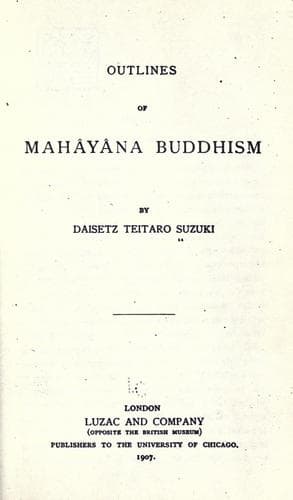
Outlines of Mahayana BuddhismSuzuki, Daisetz Teitaro
Religion
Outlines of Mahayana Buddhism
Suzuki, Daisetz Teitaro
Mahayana Buddhism -- Doctrines
Here, a very interesting question suggests itself: Which is the
original and which is the copy, Mahâyânism or Vedantism? Most of
European Sanskrit scholars would fain wish to dispose of it at once by
declaring that Buddhism must be the borrower. But I am strongly
inclined to the opposite view, for there is reliable evidence in favor
of it. In a writing of Açvaghoṣa, who dates much earlier than Çankara
or Badarayana we notice this distinction of absolute Suchness and
relative Suchness. He writes in his _Awakening of Faith_ (p. 55 et
seq.) that though Suchness is free from all modes of limitation and
conditionality, and therefore it cannot be thought of by our finite
consciousness, yet on account of Avidyâ inherent in the human mind
absolute Suchness manifests itself in the phenomenal world, thereby
subjecting itself to the law of causality and relativity and proceeds
to say that there is a twofold aspect in Suchness from the point of
view of its explicability. The first aspect is trueness as negation
(_çûnyatâ_) in the sense that it is completely set apart from the
attributes of all things unreal, that it is a veritable reality. The
second aspect is trueness as affirmation (_açûnyatâ_), in the sense
that it contains infinite merits, that it is self-existent. Considering
the fact that Açvaghoṣa comes earlier than any Vedanta philosophers,
it stands to reason to say that the latter might have borrowed the
idea of distinguishing the two aspects of Brahma from their Buddhist
predecessors.
Çankara also makes a distinction between _saguna_ and _nirguna vidya_,
whose parallel we find in the Mahâyânist _samvṛtti_ and _paramârtha
satya_.
[55] While passing, I cannot help digressing and entering on a
polemic in this footnote. The fact is, Western Buddhist critics
stubbornly refuse to understand correctly what is insisted by Buddhists
themselves. Even scholars who are supposed to be well informed about
the subject, go astray and make false charges against Buddhism. Max
Mueller, for example, declares in his _Six Systems of Indian
Philosophy_ (p. 242) that “An important distinction between Buddhists
and Vedantists is that the former holds the world to have arisen from
what is not, the latter from what is, the Sat or Brahman.” The reader
who has carefully followed my exposition above will at once detect in
this Max Mueller’s conclusion an incorrect statement of Buddhist
doctrine. As I have repeatedly said, Suchness, though described in
negative terms, is not a state of nothingness, but the highest possible
synthesis that the human intellect can reach. The world did not come
from the void of Suchness, but from its fulness of reality. If it were
not so, to where does Buddhism want us to go after deliverance from
the evanescence and nothingness of the phenomenal world?
Public-domain text, read in full here on John Shaqi.
Reviews
Reviews
No reviews yet
Be the first to share your thoughts on this work.
Elsewhere in the archive
Join the Discussion
Join the discussion
Sign in to leave a comment or review.
Sign InorCreate an account