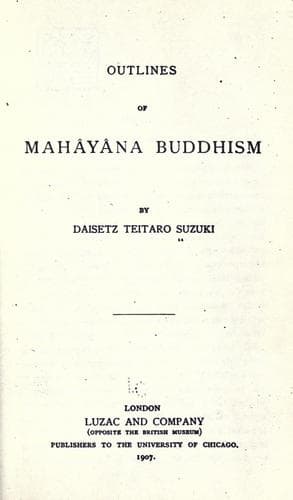
Outlines of Mahayana BuddhismSuzuki, Daisetz Teitaro
Religion
Outlines of Mahayana Buddhism
Suzuki, Daisetz Teitaro
Mahayana Buddhism -- Doctrines
[64] This view of the oneness of the Âlaya or Citta (mind) may not
be acceptable to some Mahâyânists, particularly to those who advocate
the Yogâcâra philosophy; but the present author is here trying to
expound a more orthodox and more typical and therefore more
widely-recognised doctrine of Mahâyânism, i.e., that of Açvaghoṣa.
CHAPTER VII NOTES.
[65] _Pudgala_ or _pudgalasamjña_ is sometimes used by Mahâyânists
as a synonym of âtman. The Buddhist âtman in the sense of
ego-substratum may be considered to correspond to the Vedantist
Jîvâtman, which is used in contradistinction to Paramâtman, the
supreme being or Brahma.
[66] Mahâyâna Buddhists generally understand the essential
characteristic of âtman to consist in freedom, and by freedom they
mean eternality, absolute unity, and supreme authority. A being that
is transitory is not free, as it is conditioned by other beings, and
therefore it has no âtman. A being that is an aggregate of elemental
matter or forms of energy is not absolute, for it is a state of mutual
relationship, and therefore it has no âtman. Again, a being that has
no authoritative command over itself and other beings, is not free,
for it will be subjected to a power other than itself, and therefore
it has no âtman. Now, take anything that we come across in this world
of particulars; and does it not possess one or all of these three
qualities: transitoriness, compositeness, and helplessness or
dependence? Therefore, all concrete individual existences not
excepting human beings have no âtman, have no ego, that is eternal,
absolute, and supreme.
[67] Tent-designer is a figurative term for the ego-soul. Following
the prevalent error, the Buddha at first made an earnest search after
the ego that was supposed to be snugly sitting behind our mental
experiences, and the result was this utterance.
[68] _The Dharmapada_, vs. 153-154. Tr. by A. J. Edmunds.
[69] _Prakṛtivikṛtayas._ This is a technical term of Sâmkhya
philosophy and means the modes of Prakrti, as evolved from it and as
further evolving on. See Satis Chandra Banarji, _Samkhya-Philosophy_,
p. XXXIII et seq.
[70] The passages quoted here as well as one in the next paragraph
are taken from Açvaghoṣa’s _Buddhacarita_.
[71] _The Questions of King Milinda, Sacred Books of the East_,
Vol. XXXV.
[72] This reminds us of the passage quoted elsewhere from the
_Katha-Upanishad_; cf. the footnote to it.
[73] As cited elsewhere, Bodhi-Dharma of the Dhyâna sect, when
questioned in a similar way, replied, “I do not know.” Walt Whitman
echoes the same sentiment in the following lines:
“A child said, what is the grass? fetching it to me with full hands;
How could I answer the child? I do not know what it is, any more than
he.”
Public-domain text, read in full here on John Shaqi.
Reviews
Reviews
No reviews yet
Be the first to share your thoughts on this work.
Elsewhere in the archive
Join the Discussion
Join the discussion
Sign in to leave a comment or review.
Sign InorCreate an account