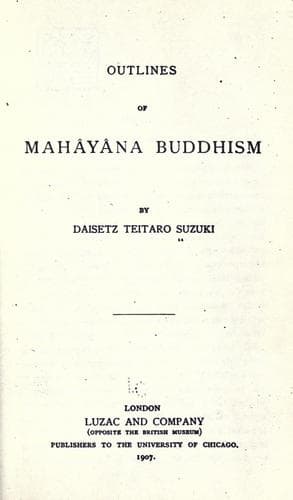
Outlines of Mahayana BuddhismSuzuki, Daisetz Teitaro
Religion
Outlines of Mahayana Buddhism
Suzuki, Daisetz Teitaro
Mahayana Buddhism -- Doctrines
[74] There seem to be two Chinese translations of this Sûtra, one
by Kumârajîva and the other by Paramârtha, but apparently they are
different texts bearing the same title. Besides these two, there is
another text entirely in Chinese transliteration. Owing to
insufficiency of material at my disposal here, I cannot say anything
definite about the identity or diversity of these documents. The
following discussion that is reported to have taken place between the
Buddha and Ananda is an abstract prepared from the first and the
second fasciculi of Paramârtha’s (?) translation. Beal gives in his
_Catena of Buddhist Scriptures from the Chinese_ (pp. 286-369) an
English translation of the first four fasc. of the _Surangama_. Though
this translation is not quite satisfactory in many points the reader
may find there a detailed account of the discussion which is here only
partially and roughly recapitulated.
[75] Cf. the following which is extracted from the _Questions of
King Milinda_ (Sacred Books of the East, vol. XXXV, 133): “If there be
a soul [distinct from the body] which does all this, then if the door
of the eye were thrown down [if the eye were plucked out] could it
stretch out its head, as it were, through the larger aperture and
[with greater range] see forms much more clearly than before? Could
one hear sounds better if the ears were cut off, or taste better if
the tongue were pulled out, or feel touch better if the body were
destroyed?”
[76]
Nirvikalpo ‘smi ciddipo nirahankaravasanaḥ
Tvaya ahankarabijena na sambaddho ‘smi asanmaya (31)
[77]
Yathâ bhûtatayâ na ahammano na tvam na vâsanâ
Atmâ çuddhacidabhasaḥ kevalo yam vijṛbhate. (44)
[78] The following is a somewhat free translation of the original
Chinese of Kumârajîva, which pretty closely agrees with the Sanskrit
text published by the Buddhist Text Society of India.
[79] The Sanskrit text does not give this passage.
[80]
Lakṣyâl lakṣaṇam anyac cet syât tal lakṣyam alakṣanam.
[81]
Rûpâdi vyatirekena yathâ kumbho na vidyate,
Vâhyâdi vyatireṇa tathâ rûpam na vidyate.
[82] Abstracted from Pingalaka’s _Commentary on the Mâdhyamika
Çâstra_, Chapter VII. The Chinese translation is by Kumârajîva.
[83] The passage in parentheses is taken from Chandrakîrti’s
_Commentary on Nâgârjuna_, pp. 180-181.
CHAPTER VIII NOTES.
[84] The Twelve Nidânas are: (1) Ignorance (_avidyâ_), (2) action
(_sanskâra_), (3) Consciousness (_vijñâna_), (4) Name-and-form
(_nâmarûpa_), (5) Six Sense-organs (_âyatana_), (6) Contact (_sparça_),
(7) Sensation (_vedanâ_), (8) Desire (_trṣnâ_), (9) Attachment
(_upâdâna_), (10) Procreation (_bhâva_), (11) birth (_jati_), (12) Old
Age, Death, etc. (_jarâ_, _marana_, _çoka_, etc.).
[85] From a Chinese Mahâyâna sutra.
[86] The Pâli Jâtaka, no. 222. Translation by W. H. Rouse.
[87] Warren’s _Buddhism in Translations_, p. 214.
[88] _On the Completion of Karma_, by Vasubandhu. Nanjo, No. 1222.
Public-domain text, read in full here on John Shaqi.
Reviews
Reviews
No reviews yet
Be the first to share your thoughts on this work.
Elsewhere in the archive
Join the Discussion
Join the discussion
Sign in to leave a comment or review.
Sign InorCreate an account