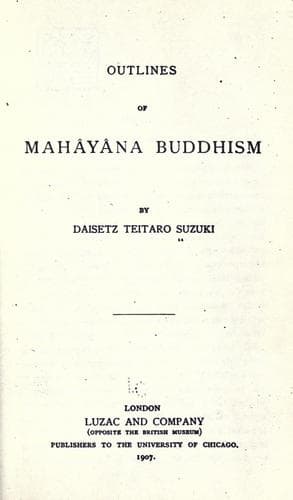
Outlines of Mahayana BuddhismSuzuki, Daisetz Teitaro
Religion
Outlines of Mahayana Buddhism
Suzuki, Daisetz Teitaro
Mahayana Buddhism -- Doctrines
[116] The reader must not think that there is but one Pure Land
which is elaborately described in the _Sukhâvatî Vyûha Sûtra_ as the
abode of the Tathâgata Amitâbha, situated innumerable leagues away in
the West. On the contrary, the Mahâyâna texts admit the existence of
as innumerable pure lands as there are Tathâgatas and Bodhisattvas,
and every single one of these holy regions has no boundary and is
coexistent with the universe, and, therefore, their spheres necessarily
intercrossing and overlapping one another. It would look to every
intelligent mind that those innumerable Buddha-countries existing in
such a mysterious and incomprehensible manner cannot be anything else
than our own subjective creation.
[117] For a description of these marks see the _Dharmasangraha_, pp.
53 ff. A process of mystifying or deifying the person of Buddha seems
to have been going on immediately after the death of the Master; and
the Mahâyânistic conception of Nirmânakâya and Sambhogakâya is merely
the consummation of this process. Southern Buddhists who are sometimes
supposed to represent a more “primitive” form of Buddhism describe
just as much as Mahâyânism the thirty-two major and eighty minor
excellent physical marks of a great man as having been possessed by
Çâkyamuni, (for instance, see the _Milindapañha_, _S. B. E._ Vol. XXXV.
p. 116). But any person with common sense will at once see the
absurdity of representing any human being with those physical
peculiarities. And this seems to have inspired more rational
Mahâyânists to abandon the traditional way of portraying the human
Buddha with those mysterious signs. They transferred them through the
doctrine of Trikâya to the characterisation of the Sambhogakâya
Buddha, that is, to the Buddha enjoying in a celestial abode the fruit
of his virtuous earthly life. The Buddha who walked in the flesh as
the son of King Suddhodana was, however, no more than an ordinary
human being like ourselves, because he appeared to us in a form of
Nirmânakâya, i.e. as a Body of Transformation, devoid of any such
physical peculiarities known as thirty-two or eighty lakṣanas.
Southern Buddhists, so called, seem, however, to have overlooked the
ridiculousness of attributing these fantastic signs to the human
Buddha; and this fact explains that as soon as the memory of the
personal disciples of Buddha about his person vanished among the later
followers, intense speculation and resourceful imagination were
constantly exercised until the divers schools settled the question
each in its own way.
[118] Cf. I Cor. XI. 19 et seq.
CHAPTER XI NOTES.
[119]
Kern’s English translation (_S. B. E._ Vol. XXI), Chap. III, p. 80.
Public-domain text, read in full here on John Shaqi.
Reviews
Reviews
No reviews yet
Be the first to share your thoughts on this work.
Elsewhere in the archive
Join the Discussion
Join the discussion
Sign in to leave a comment or review.
Sign InorCreate an account