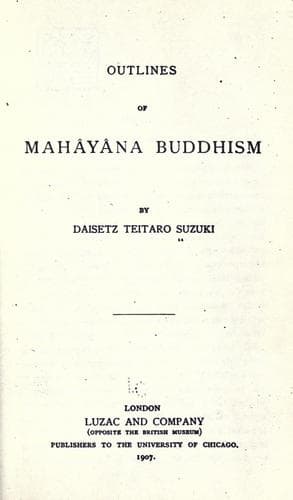
Outlines of Mahayana BuddhismSuzuki, Daisetz Teitaro
Religion
Outlines of Mahayana Buddhism
Suzuki, Daisetz Teitaro
Mahayana Buddhism -- Doctrines
[113] Cf. I Cor. XIII, II. “When I was a child, I spake as a child,
I understood as a child, I thought as a child, but when I became a
man, I put away childish things.” This point of our ever-ascending
spiritual progress is well illustrated in the _Saddharma-pundarîka
Sûtra_. See Chapters II, III, IV, V, and XI. The following passage
quoted from chap. II, p. 49 (Kern’s translation) will give a tolerably
adequate view concerning diversity of means and unity of purpose as
here expounded: “Those highest of men have, all of them, revealed most
holy laws by means of illustrations, reasons and arguments, with many
hundred proofs of skillfulness (_upâyakauçalya_). And all of them have
manifested but one vehicle and introduced but one on earth; by one
vehicle have they led to full ripeness inconceivably many thousands of
kotis of beings.” As was elsewhere noted, this doctrine is sometimes
known as the theory of Upâya. Upâya is very difficult term to translate
into English; it literally means “way,” “method,” or “strategy.” For
fuller interpretation see p. 298, footnote.
[114] This is one of the most important philosophical works of the
Yogacâra school. Vasubandhu wrote the text (Nanjo, No. 1215) which
consists only of thirty verses, but there appeared many commentators
after the death of the author, who naturally entertained widely
different views among themselves on the subject-matter, as it is too
tersely treated in the text. Hsüen Tsang made selections out of the
ten noted Hindu exegetists in A.D. 659 and translated them into the
Chinese language. The compilation consists of ten fascicles and is
known as _Discourse on the Ideality of the Universe_ (a free rendering
of the Chinese title _Chang wei shi lun_, Nanjo, No. 1197).
[115] May I venture to say that the conception of God as entertained
by most Christians is a Body of Bliss rather than the Dharmakâya
itself? In some respects their God is quite spiritual, but in others
he is thought of as a concrete material being like ourselves. It seems
to me that the human soul is ever struggling to free itself from this
paradox, though without any apparent success, while the masses are not
so intellectual and reflective enough as to become aware of this
eternal contradiction which is too deeply buried in their minds.
Public-domain text, read in full here on John Shaqi.
Reviews
Reviews
No reviews yet
Be the first to share your thoughts on this work.
Elsewhere in the archive
Join the Discussion
Join the discussion
Sign in to leave a comment or review.
Sign InorCreate an account