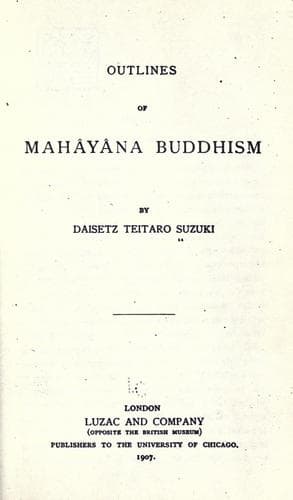
Outlines of Mahayana BuddhismSuzuki, Daisetz Teitaro
Religion
Outlines of Mahayana Buddhism
Suzuki, Daisetz Teitaro
Mahayana Buddhism -- Doctrines
[124] The full title of the work is _A Treatise on the
Transcendentality of Bodhicitta_ (Nanjo, No. 1304). It is a little
book consisting of seven or eight sheets in big Chinese type. It was
translated into Chinese by Dânapâla (Shih Hu) during the tenth century
of the Christian Era.
[125] Upaya, meaning “expedient,” “stratagem,” “device,” or “craft,”
has a technical sense in Buddhism. It is used in contrast to
intelligence (_prajñâ_) and is synonymous with love (_karunâ_). So,
Vimalakîrti says in the sûtra bearing his name (chap. 8, verses 1-4):
“Prajñâ is the mother of the Bodhisattva and Upaya his father; there
is no leader of humanity who is not born of them.” Intelligence
(_prajñâ_) is the one, the universal, representing the principle of
sameness (_samatâ_), while Upaya is the many, being the principle of
manifoldness (_nânâtvâ_). From the standpoint of pure intelligence,
the Bodhisattvas do not see any particular suffering existences, for
there is nothing that is not of the Dharmakâya: but when they see the
universe from the standpoint of their love-essence, they recognise
everywhere the conditions of misery and sin that arise from clinging
to the forms of particularity. To remove these, they devise all
possible means that are directed towards the attainment of the final
aim of existence. There is only one religion, religion of truth, but
there are many ways, many means, many upayas, all issuing from the
all-embracing love of the Dharmakâya and equally efficient to lead the
masses to supreme enlightenment and universal good. Therefore,
ontologically speaking, this universe, the Buddhists would say, is
nothing but a grand display of Upayas by the Dharmakâya that desires
thereby to lead all sentient beings to the ultimate realisation of
Buddhahood. In many cases, thus, it is extremely difficult to render
upaya by any of its English equivalents and yet to retain its original
technical sense unsuffered. This is also the case with many other
Buddhist terms, among which we may mention Bodhi, Dharmakâya, Prajñâ,
Citta, Parivarta, etc. The Chinese translators have _fang p’ien_ for
upaya which means “means-accommodation.”
[126] Its full title is _A Discourse on the Non-duality of the
Mahâyâna-Dharmadhâtu_. It consists of less than a dozen pages in
ordinary Chinese large print. It was translated by Deva-prajñâ and
others in the year 691 A.D.
[127] This work was translated by Kumârajîva into Chinese at the
beginning of the fifth century A.D. It is divided into two fascicles,
each consisting of about one score of Chinese pages.
[128] The above is a liberal rendering of the first part of the
Chapter III, in Vasubandhu’s _Bodhicitta_.
CHAPTER XII NOTES.
Public-domain text, read in full here on John Shaqi.
Reviews
Reviews
No reviews yet
Be the first to share your thoughts on this work.
Elsewhere in the archive
Join the Discussion
Join the discussion
Sign in to leave a comment or review.
Sign InorCreate an account