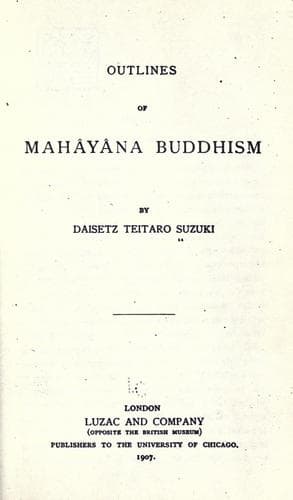
Outlines of Mahayana BuddhismSuzuki, Daisetz Teitaro
Religion
Outlines of Mahayana Buddhism
Suzuki, Daisetz Teitaro
Mahayana Buddhism -- Doctrines
[129] The distinction between the five indriyas and the five balas
seems to be rather redundant. But the Hindu philosophers usually
distinguish actor from action, agent from function or operation. Thus
the sense-organs are distinguished from sensations or
sense-consciousnesses, and the manovijñâna (mind) from its functions
such as thinking, attention, memory, etc. The âtman has thus come to
be considered the central agent that controls all the sensuous and
intellectual activities. Though the Buddhists do not recognise this
differentiation of actor and action in reality, they sometimes loosely
follow the popular usage.
[130] In this connection it is very interesting also to note that
Carlyle expresses the same sentiment about the greatness of Shakespeare
in his _Hero Worship_. “If I say that Shakspeare is the greatest of
Intellects, I have said all concerning him. But there is more in
Shakspeare’s intellect than we have yet seen It is what I call an
unconscious intellect; there is more virtue in it that he himself is
aware of. Novalis beautifully remarks of him, that those dramas of his
are Products of Nature too, as deep as Nature herself. I find a great
truth in this saying, Shakspeare’s Art is not Artifice; the noblest
worth of it is not there by plan or precontrivance. It grows from the
deeps of Nature, through this noble sincere soul, who is a voice of
Nature.”
[131] The ten powers of the Buddha are: (1) The mental power which
discriminates between right and wrong, (2) The knowledge of the
retribution of karma, (3) The knowledge of all the different stages of
creation, (4) The knowledge of all the different forms of deliverance,
(5) The knowledge of all the different dispositions of sentient
beings, (6) The knowledge of the final destination of all deeds, (7)
The knowledge of all the different practices of meditation,
deliverance, and tranquilisation, (8) The knowledge of former
existences, (9) The unlimited power of divination, (10) The knowledge
of the complete subjection of evil desires (_âçrava_).
[132] The four convictions (_vaiçâradyas_) of the Buddha are: (1)
That he has attained the highest enlightenment, (2) That he has
destroyed all evil desires, (3) That he has rightly described the
obstacles that lie in the way to a life of righteousness, (4) That he
has truthfully taught the way of salvation.
Public-domain text, read in full here on John Shaqi.
Reviews
Reviews
No reviews yet
Be the first to share your thoughts on this work.
Elsewhere in the archive
Join the Discussion
Join the discussion
Sign in to leave a comment or review.
Sign InorCreate an account