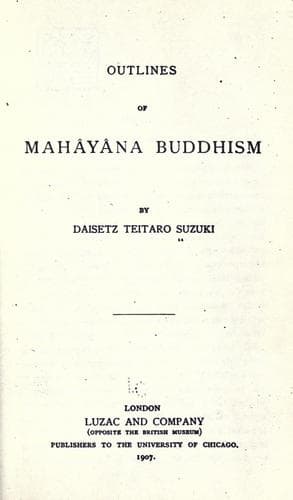
Outlines of Mahayana BuddhismSuzuki, Daisetz Teitaro
Religion
Outlines of Mahayana Buddhism
Suzuki, Daisetz Teitaro
Mahayana Buddhism -- Doctrines
[147] Cf. the following from the _Mâdhyamika_:
“Bhaved abbâvo bhâvaç ca nirvânam ubhayam katham:
Asamskṛtam ca nirvânam bhâvâbhavâi ca samskṛtam.”
Or, “Tasmânna bhâvo nâbhâvo nirvânamiti yujyate.”
[148] In the _Visuddhi-Magga_ XXI. (Warren’s translation, p. 376 et
seq.), we read that there are three starting points of deliverance
arising from the consideration of the three predominant qualities of
the constituents of being: 1. The consideration of their beginnings
and ends leads the thoughts to the unconditioned; 2. The insight into
their miserableness agitates the mind and leads the thoughts to the
desireless; 3. The consideration of the constituents of being as not
having an ego leads the thoughts to the empty. And these three, we are
told, constitute the three aspects of Nirvâna as unconditioned,
desireless, and empty. Here we have an instance in the so-called
Southern “primitive” Buddhism of viewing Nirvâna in the Mahâyânistic
light which I have here explained at length.
_En passant_, let us remark that as Buddha did not leave any document
himself embodying his whole system, there sprang up soon after his
departure several schools explaining the Master’s view in divers ways,
each claiming the legitimate interpretation; that in view of this fact
it is illogical to conclude that Southern Buddhism is the authoritative
representation par excellence of original Buddhism, while the Eastern
or the Northern is a mere degeneration.
[149] There are three Chinese translations of this Mahâyâna text, by
Dharmarakṣa, Kumârajîva, and Bodhiruci, between 265 and 517 A.D.
[150]
Samsârasya ca nirvânât kincid asti viçeṣaṇam:
Na nirvâṇasya samsârât kincid asti viçesaṇam.
[151]
Nirvâṇasya ca yâ kotiḥ kotiḥ samsârasya ca,
Vidyâdanantaraṃ kincit susukṣnaṃ vidyate.
[152] Concerning the similarity in meaning of this statement to the
one just preceding, a commentator says that the sixth is the statical
view of Suchness (or Dharmakâya) and the seventh its dynamical view.
One explains what the highest reality of Buddhism is and the other
what it does or works.
[153] _The Discourse on Buddha-essence_ by Vasubandhu. The Japanese
Tripitaka edition of 1881, fas. II., p. 84, where the stanza is quoted
from the _Sûtra on the Incomprehensible_.
[154] This is expressed in the first verse of the _Mâdhyamika
Çâstra_, which runs as follows:
“Anirodham anutpâdam anucchedam açâçvatam
Anekârtham anânârtham anâgamam anirgamam.”
Literally translated these lines read:
“No annihilation, no production, no destruction, no persistence,
No unity, no plurality, no coming in, no going out.”
Public-domain text, read in full here on John Shaqi.
Reviews
Reviews
No reviews yet
Be the first to share your thoughts on this work.
Elsewhere in the archive
Join the Discussion
Join the discussion
Sign in to leave a comment or review.
Sign InorCreate an account