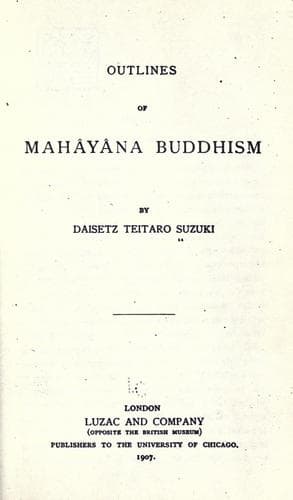
Outlines of Mahayana BuddhismSuzuki, Daisetz Teitaro
Religion
Outlines of Mahayana Buddhism
Suzuki, Daisetz Teitaro
Mahayana Buddhism -- Doctrines
[137] The _Buddhacarita_, Cowell’s translation in the _S. B. E._
Vol. XLIX. p. 145.
[138] From A. J. Edmunds’s translation of _Dhammapada_.
[139] P. 225. Beal’s translation is not always reliable, and I
would have my own if the Chinese original were at all accessible.
[140] The gâthâs supposed to be the first utterance of the Buddha
after his enlightenment, according to Rockhill’s _Life of the Buddha_
(p. 33) compiled from Tibetan sources, give an inkling of nihilism,
though I am inclined to think that the original Tibetan will allow a
different interpretation when examined by some one who is better
acquainted with the spirit of Buddhism than Rockhill. Rockhill betrays
in not a few cases his insufficient knowledge of the subject he treats.
His translation of the gâthâs is as follows:
“All the pleasures of the worldly joys,
All which are known among the gods,
Compared with the joy of ending existence,
Are not as its sixteenth part.
“Sorry is he whose burden is heavy,
And happy he who has cast it down;
When once he has cast off his burden,
He will seek to be burthened no more.
“When all existences are put away,
When all notions are at an end,
When all things are perfectly known,
Then no more will craving come back.”
In the _Udâna_, II., 2, we have a stanza corresponding to the first
gâthâ here cited, but the _Udâna_ does not say “the joy of ending
existence,” but “the destruction of desire.”
According to the _Lalita Vistara_, the Buddha’s utterance of victory
is (Râjendra Mitra’s Edition p. 448):
“Cinna vartmopaçânta rajâh çuṣkâ âçravâ na punaḥ çravanti.
Chinne vartmani varttate duḥkhasyaiṣonta ucyate.”
[141] Warren’s _Buddhism in Translations_, p. 376.
[142] General D. M. Strong’s translation, p. 64.
[143] The text does not expressly say “animate or inanimate”, but
this is the author’s own interpretation according to the general
spirit of Mahâyânism.
[144] There are two obstacles to final emancipation: (1) affective,
and (2) intellectual. The former is our unenlightened affective or
emotional or subjective life and the latter our intellectual prejudice.
Buddhists should not only be pure in heart but be perfect in
intelligence. Pious men are of course saved from transmigration, but
to attain perfect Buddhahood they must have a clear, penetrating
intellectual insight into the significance of life and existence and
the destiny of the universe. This emphasising of the rational element
in religion is one of the most characteristic points of Buddhism.
[145] This is one of the most important philosophical texts of
Mahâyânism. Its original Sanskrit with the commentary of Chandra Kîrti
has been edited by Satis Chandra Acharya and published by the Buddhist
Text Society of India. The original lines run as follows (p. 193):
“Aprahînam, asamprâptam, anucchinnam, açâçvatam,
Aniruddham, anutpannam, evam nirvânam ucyate.”
[146] Literally, that which is characterised by the absence of all
characterisation.
Public-domain text, read in full here on John Shaqi.
Reviews
Reviews
No reviews yet
Be the first to share your thoughts on this work.
Elsewhere in the archive
Join the Discussion
Join the discussion
Sign in to leave a comment or review.
Sign InorCreate an account