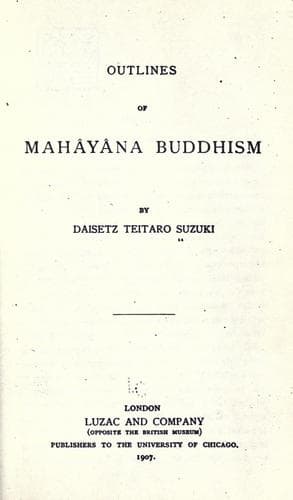
Outlines of Mahayana BuddhismSuzuki, Daisetz Teitaro
Religion
Outlines of Mahayana Buddhism
Suzuki, Daisetz Teitaro
Mahayana Buddhism -- Doctrines
Suppose, on the other hand, there were an âtman behind every
particular being; suppose, too, it were absolute and permanent and
self-acting; and this phenomenal world would then come to a
standstill, and life be forever gone. For is not changeability the
most essential feature and condition of life, and also the strongest
evidence for the non-existence of individual things as realities? The
physical sciences recognise this universal fact of mutual
transformation in its positive aspect and call it the law of the
conservation of energy and of matter. Mahâyânism, recognising its
negative side, proposes the doctrine of the non-âtman-ness of things,
that is to say, the {44} impermanency of all particular existences.
Therefore, it is said, “_Sarvam anityam, sarvam çûnyam, sarvam
anâtman_.” (All is transitory, all is void, all is without ego.)
Mahâyânists condemn the vulgar view that denies the consubstantiality
and reciprocal transformation of all beings, not only because it is
scientifically untenable, but mainly because, ethically and religiously
considered, it is fraught with extremely dangerous ideas,--ideas which
finally may lead a “brother to deliver up the brother to death and the
father the child,” and, again, it may constrain “the children to rise
up against their parents and cause them to be put to death.” Why?
Because this view, born of egoism, would dry up the well of human love
and sympathy, and transform us into creatures of bestial selfishness;
because this view is not capable of inspiring us with the sense of
mutuality and commiseration and of making us disinterestedly feel for
our fellow-beings. Then, all fine religious and humane sentiments
would depart from our hearts, and we should be nothing less than rigid,
lifeless corpses, no pulse beating, no blood running. And how many
victims are offered every day on this altar of egoism! They are not
necessarily immoral by nature, but blindly led by the false conception
of life and the world, they have been rendered incapable of seeing
their own spiritual doubles in their neighbors. Being ever controlled
by their sensual impulses, they sin against humanity, against nature,
and against themselves.
{45}
We read in the _Mahâyâna-abhisamaya Sûtra_ (Nanjo, no. 196):
“Empty and calm and devoid of ego
Is the nature of all things:
There is no individual being
That in reality exists.
“Nor end nor beginning having
Nor any middle course,
All is a sham, here’s no reality whatever:
It is like unto a vision and a dream.
“It is like unto clouds and lightning,
It is like unto gossamer or bubbles floating
It is like unto fiery revolving wheel,
It is like unto water-splashing.
“Because of causes and conditions things are here:
In them there’s no self-nature [i.e., âtman]:
All things that move and work,
Know them as such.
“Ignorance and thirsty desire,
The source of birth and death they are:
Right contemplation and discipline by heart,
Desire and ignorance obliterate.
Public-domain text, read in full here on John Shaqi.
Reviews
Reviews
No reviews yet
Be the first to share your thoughts on this work.
Join the Discussion
Join the discussion
Sign in to leave a comment or review.
Sign InorCreate an account