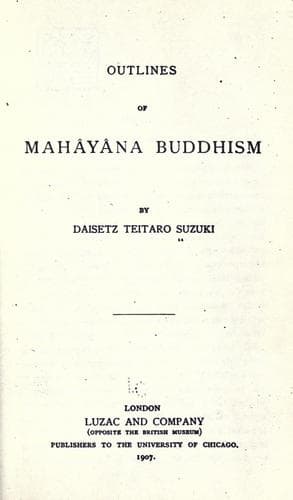
Outlines of Mahayana BuddhismSuzuki, Daisetz Teitaro
Religion
Outlines of Mahayana Buddhism
Suzuki, Daisetz Teitaro
Mahayana Buddhism -- Doctrines
The meaning of Nirvâna has been variously interpreted by non-Buddhist
students from the philological and the historical standpoint; but it
matters little what conclusions they have reached, as we are not going
to recapitulate them here; nor do they at all affect our presentation
of the Buddhists’ own view as below. For it is the latter that concerns
us here most and constitutes the all-important part of the problem. We
have had too much of non-Buddhist speculation on the question at issue.
The majority of the critics, while claiming to be fair and impartial,
have, by some preconceived ideas, been led to a conclusion, which is
not at all acceptable to intelligent Buddhists. Further, the fact has
escaped their notice that Pâli literature from which they chiefly
derive their information on the subject represents the views of one of
the many sects that arose soon after the demise of the Master and were
constantly branching off at and after the time of King Açoka. The
probability is, that Buddha himself did not have any stereotyped
conception of Nirvana, and, as most great minds do, expressed his ideas
outright as formed under various circumstances; though of course they
could not be {50} in contradiction with his central beliefs, which must
have remained the same throughout the course of his religious life.
Therefore, to understand a problem in all its apparently contradictory
aspects, it is very necessary to grasp at the start the spirit of the
author of the problem, and when this is done the rest will be
understood comparatively much easier. Non-Buddhist critics lack in
this most important qualification; therefore, it is no wonder that
Buddhists themselves are always reluctant to accede to their
interpretations.
Enough for apology. Nirvâna, according to Buddhists, does not signify
an annihilation of consciousness nor a temporal or permanent
suppression of mentation[12], as imagined by some; but it is the {51}
annihilation of the notion of ego-substance and of all the desires
that arise from this erroneous conception. But this represents the
negative side of the doctrine, and its positive side consists in
universal love or sympathy (_karunâ_) for all beings.
Public-domain text, read in full here on John Shaqi.
Reviews
Reviews
No reviews yet
Be the first to share your thoughts on this work.
Join the Discussion
Join the discussion
Sign in to leave a comment or review.
Sign InorCreate an account