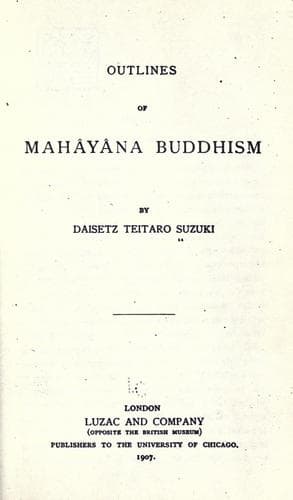
Outlines of Mahayana BuddhismSuzuki, Daisetz Teitaro
Religion
Outlines of Mahayana Buddhism
Suzuki, Daisetz Teitaro
Mahayana Buddhism -- Doctrines
As stated in the Introduction, the term Mahâyâna was invented in the
times of Nâgârjuna and Âryadeva (about the third or fourth century
after Christ), when doctrinal struggles between the Çrâvaka and the
Bodhisattva classes reached a climax. The progressive Hindu Buddhists,
desiring to announce the essential features of their doctrine, did so
naturally at the expense of their rival and by pointing out why theirs
was greater than, or superior to, Hînayânism. Their views were thus
necessarily vitiated by a partisan spirit, and instead of impartially
and critically enumerating the principal characteristics of Mahâyânism,
they placed rather too much stress upon those points that do not in
these latter days appear to be very essential, but that were then
considered by them to be of paramount importance. These points,
nevertheless, {61} throw some light on the nature of Mahâyâna Buddhism
as historically distinguished from its consanguineous rival and
fellow-doctrine.
_Sthiramati’s Conception of Mahâyânism._
Sthiramati[20] in his _Introduction to Mahâyânism_ states that
Mahâyânism is a special doctrine for the Bodhisattvas, who are to be
distinguished from the other two classes, viz, the Çrâvakas and the
Pratyekabuddhas. The essential difference of the doctrine consists in
the belief that objects of the senses are merely phenomenal and have
no absolute reality, that the indestructible Dharmakâya which is
all-pervading constitutes the norm of existence, that all
Bodhisattvas[21] are incarnations of the Dharmakâya, who not by
their evil karma previously accumulated, but by their boundless love
for all mankind, assume {62} corporeal existences, and that persons
who thus appear in the flesh, as avatars of the Buddha supreme,
associate themselves with the masses in all possible social relations,
in order that they might thus lead them to a state of enlightenment.
While this is a very summary statement of the Mahâyâna doctrine, a
more elaborate and extended enumeration of its peculiar features in
contradistinction to those of Hînayânism, is made in the _Miscellanea
on Mahâyâna Metaphysics_,[22] _The Spiritual Stages of the
Yogâcâra_,[23] _An Exposition of the Holy Doctrine_,[24] _A
Comprehensive Treatise on Mahâyânism_,[25] and others. Let us first
explain the “Seven General Characteristics” as described in the first
three works here mentioned.
_Seven Principal Features of Mahâyânism._
According to Asanga, who lived a little later than Nâgârjuna, that
is, at the time when Mahâyânism was further divided into the Yogâcârya
and the Mâdhyamika school, the seven features peculiar to Mahâyânism
as distinguished from Hînayânism, are as follows:
Public-domain text, read in full here on John Shaqi.
Reviews
Reviews
No reviews yet
Be the first to share your thoughts on this work.
Join the Discussion
Join the discussion
Sign in to leave a comment or review.
Sign InorCreate an account