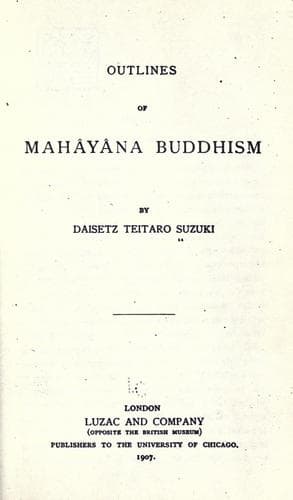
Outlines of Mahayana BuddhismSuzuki, Daisetz Teitaro
Religion
Outlines of Mahayana Buddhism
Suzuki, Daisetz Teitaro
Mahayana Buddhism -- Doctrines
(7) As Mahâyânism insists on the purification of the inner life, its
teaching applies not to things outward, its principles are not of the
ascetic and exclusive kind. The Mahâyânists do not shun to commingle
themselves with the “dust of worldliness”; they aim at the realisation
of the Bodhi; they are not afraid of being thrown into the whirlpool
of metempsychosis; they endeavor to impart spiritual benefits to all
sentient beings without regard to their attitude, whether hostile or
friendly, towards themselves; having immovable faith in the Mahâyâna,
they never become contaminated by vanity and worldly pleasures with
which they may constantly be in touch; they have a clear insight into
the doctrine of non-âtman; being free from all spiritual faults, they
live in perfect accord with the laws of Suchness and discharge their
duties without the {72} least conceit or self-assertion: in a word,
their inner life is a realisation of the Dharmakâya.
(8) The intellectual superiority of the Bodhisattva is shown by his
possession of knowledge of non-particularisation (_anânârtha_).[34]
This knowledge, philosophically considered, is the knowledge of the
absolute, or the knowledge of the universal. The Bodhisattva’s mind is
free from the dualism of samsâra (birth-and-death) and nirvâna, of
positivism and negativism, of being and non-being, of object and
subject, of ego and non-ego. His knowledge, in short, transcends the
limits of final realities, soaring high to the realm of the absolute
and the abode of non-particularity.
(9) In consequence of this intellectual elevation, the Bodhisattva
perceives the working of birth and death in nirvâna, and nirvâna in
the transmigration of birth and death. He sees the “ever-changing
many” in the “never-changing one,” and the “never-changing {73} one”
in the “ever-changing many.” His inward life is in accord at once with
the laws of transitory phenomena and with those of transcendental
Suchness. According to the former, he does not recoil as ascetics do
when he comes in contact with the world of the senses; he is not
afraid of suffering the ills that the flesh is heir to; but, according
to the latter, he never clings to things evanescent, his inmost
consciousness forever dwells in the serenity of eternal Suchness.
Public-domain text, read in full here on John Shaqi.
Reviews
Reviews
No reviews yet
Be the first to share your thoughts on this work.
Join the Discussion
Join the discussion
Sign in to leave a comment or review.
Sign InorCreate an account