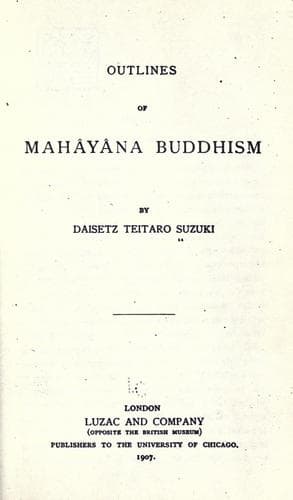
Outlines of Mahayana BuddhismSuzuki, Daisetz Teitaro
Religion
Outlines of Mahayana Buddhism
Suzuki, Daisetz Teitaro
Mahayana Buddhism -- Doctrines
Açvaghoṣa argues, in his _Awakening of Faith_ for the indefinability
of this first principle. When we say it is çûnya or empty, on account
of its being independent {100} of all the thinkable qualities, which
we attribute to things relative and conditional, people would take it
for the nothingness of absolute void. But when we define it as a real
reality, as it stands above the evanescence of phenomena, they would
imagine that there is something individual and existing outside the
pale of this universe, which, though as concrete as we ourselves are,
lives an eternal life. It is like describing to the blind what an
elephant looks like; each one of them gets but a very indistinct and
imperfect conception of the huge creature, yet every one of them
thinks he has a true and most comprehensive idea of it.[42]
Açvaghoṣa, thus, wishes to eschew all definite statements concerning
the ultimate nature of being, but as language is the only mode with
which we mortals can express our ideas and communicate them to others,
he thinks the best expression that can be given to it is Bhûtatathâtâ,
i.e., “suchness of existence,” or simply, “suchness.”
Bhûtatathâtâ (suchness), thus absolutely viewed, does not fall under
the category of being and non-being; and minds which are kept within
the narrow circle of contrasts, must be said to be incapable of
grasping it as it truly is. Says Nâgârjuna in his Çâstra (Ch. XV.):
“Between thisness (_svabhâva_) and thatness (_parabhâva_),
Between being and non-being,
Who discriminates,
The truth of Buddhism he perceives not.”[43]
{101}
Or,
“To think ‘it is’, is eternalism,
To think ‘it is not’, is nihilism:
Being and non-being,
The wise cling not to either.”[44]
Again,
“The dualism of ‘to be’ and ‘not to be,’
The dualism of pure and not-pure:
Such dualism having abandoned,
The wise stand not even in the middle.”[45]
To quote, again, from the _Awakening of Faith_ (pp. 58-59): “In its
metaphysical origin, Bhûtatathâtâ has nothing to do with things
defiled, i.e., conditional: it is free from all signs of
individualisation, such as exist in phenomenal objects: it is
independent of an unreal, particularising consciousness.”
_Indefinability._
Absolute Suchness from its very nature thus defies all definitions. We
cannot even say that it is, for everything that is presupposes that
which is not: existence and non-existence are relative terms as much
as subject and object, mind and matter, this and that, one and other:
one cannot be conceived {102} without the other. “It is not so (_na
iti_)[46],” therefore, may be the only way our imperfect human tongue
can express it. So the Mahâyânists generally designate absolute
Suchness as Çûnyatâ or void.
Public-domain text, read in full here on John Shaqi.
Reviews
Reviews
No reviews yet
Be the first to share your thoughts on this work.
Elsewhere in the archive
Join the Discussion
Join the discussion
Sign in to leave a comment or review.
Sign InorCreate an account