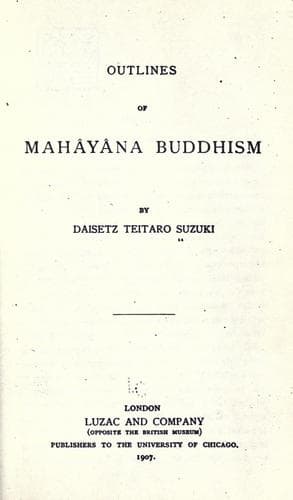
Outlines of Mahayana BuddhismSuzuki, Daisetz Teitaro
Religion
Outlines of Mahayana Buddhism
Suzuki, Daisetz Teitaro
Mahayana Buddhism -- Doctrines
But when this most significant word, çûnyatâ, is to be more fully
interpreted, we would say with Açvaghoṣa that “Suchness is neither
that which is existence nor that which is non-existence; neither that
which is at once existence and non-existence, nor that which is not at
once existence and non-existence; it is neither that which is unity
nor that which is plurality; neither that which is at once unity and
plurality, nor that which is not at once unity and plurality.”[47]
{103}
Nâgârjuna’s famous doctrine of “The Middle Path of Eight No’s”
breathes the same spirit, which declares:
“There is no death, no birth, no destruction, no persistence,
No oneness, no manyness, no coming, no departing,”[48]
Elsewhere, he expresses the same idea in a somewhat paradoxical
manner, making the historical Buddha a real concrete manifestation of
Suchness:
“After his passing, deem not thus:
‘The Buddha still is here,’
He is above all contrasts,
To be and not to be.
“While living, deem not thus:
‘The Buddha is now here.’
He is above all contrasts,
To be and not to be.”[49]
This view of Suchness as no-ness abounds in the literature of the
Dhyâna school of Mahâyânism. To cite one instance: When
Bodhi-Dharma[50], the founder {104} of the Dhyâna sect, saw Emperor
Wu of Liang dynasty (A.D. 502-556), he was asked what the first
principle of the Holy Doctrine was, he did not give any lengthy,
periphrastic statement after the manner of a philosopher, but
laconically replied, “Vast emptiness and nothing holy.” The Emperor
was bewildered and did not know how to take the words of his holy
adviser. Naturally, he did not expect such an abrupt answer, and,
being greatly disappointed, ventured another question: “Who is he,
then, that stands before me?” By this he meant to repudiate the
doctrine of absolute Suchness. His line of argument being this: If
there is nothing in the ultimate nature of things that distinguishes
between holiness and sinfulness, why this world of contrasts, where
some are revered as holy, for instance, Bodhi-Dharma who is at this
very moment standing in front of him with the mission of propagating
the holy teachings of Buddha? Bodhi-Dharma, however, was a mystic and
was fully convinced of the insufficiency of the human tongue to
express the highest truth which is revealed only {105} intuitively to
the religious consciousness. His conclusive answer was, “I do not
know”.[51]
Public-domain text, read in full here on John Shaqi.
Reviews
Reviews
No reviews yet
Be the first to share your thoughts on this work.
Elsewhere in the archive
Join the Discussion
Join the discussion
Sign in to leave a comment or review.
Sign InorCreate an account