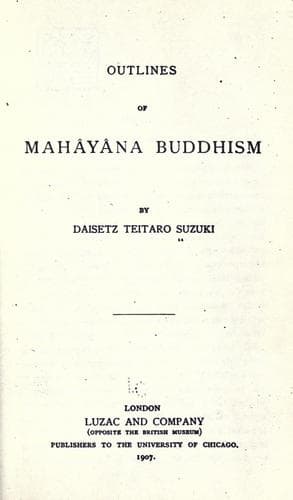
Outlines of Mahayana BuddhismSuzuki, Daisetz Teitaro
Religion
Outlines of Mahayana Buddhism
Suzuki, Daisetz Teitaro
Mahayana Buddhism -- Doctrines
This “I do not know” is not to be understood in the spirit of
agnosticism, but in the sense of “God when understood is no God,” for
_in se est et per se conceptur_. This way of describing Suchness by
negative terms only, excluding all differences of name and form
(_nâmarûpa_) to reach a higher kind of affirmation, seems to be the
most appropriate one, inasmuch as the human understanding is limited
in so many respects; but, nevertheless, it has caused much
misinterpretation even among Buddhists themselves, not to mention
those Christian Buddhist scholars of to-day, who sometimes appear
almost wilfully to misconstrue the significance of the çûnyatâ
philosophy. It was to avoid these unfortunate misinterpretations that
the Mahâyânists frequently made the paradoxical assertion that
absolute Suchness is empty and not empty, çûnya and açunya, being
and non-being, sat and asat, one and many, this and that.
_The “Thundrous Silence.”_
There yet remains another mode of explaining absolute Suchness, which
though most practical and most effective for the religiously disposed
minds, may prove very inadequate to a sceptical intellect. {106} It is
the “thundrous silence” of Vimalakîrti in response to an inquiry
concerning the nature of Suchness or the “Dharma of Non-duality,” as
it is termed in the Sûtra.[52]
Bodhisattva Vimalakîrti once asked a host of Bodhisattvas led by
Mañjuçri, who came to visit him, to express their views as to how to
enter into the Dharma of Non-duality. Some replied, “Birth and death
are two, but the Dharma itself was never born and will never die.
Those who understand this are said to enter into the Dharma of
Non-duality.” Some said, “‘I’ and ‘mine’ are two. Because I think ‘I
am’ there are things called ‘mine.’ But as there is no ‘I am’ where
shall we look for things ‘mine’? By thus reflecting we enter into the
Dharma of Non-duality.” Some replied, “Samsâra and Nirvâna are two.
But when we understand the ultimate nature of Samsâra, Samsâra
vanishes from our consciousness, and there is neither bondage nor
release, neither birth nor death. By thus reflecting we enter into the
Dharma of Non-duality”. Others said, “Ignorance and enlightenment are
two. No ignorance, no enlightenment, and there is no dualism. Why?
Because those who have entered a meditation in which there is no
sense-impression, no cogitation, are free from ignorance as well as
from enlightenment. This holds true with all the other dualistic
categories. Those who enter thus into the thought of sameness are
{107} said to enter into the Dharma of Non-duality.” Still others
answered, “To long for Nirvâna and to shun worldliness are of dualism.
Long not for Nirvâna, shun not worldliness, and we are free from
dualism. Why? Because bondage and release are relative terms, and when
there is no bondage from the beginning, who wishes to be released? No
bondage, no release, and therefore no longing, no shunning: this is
called the entering into the Dharma of Non-duality.”
Public-domain text, read in full here on John Shaqi.
Reviews
Reviews
No reviews yet
Be the first to share your thoughts on this work.
Elsewhere in the archive
Join the Discussion
Join the discussion
Sign in to leave a comment or review.
Sign InorCreate an account