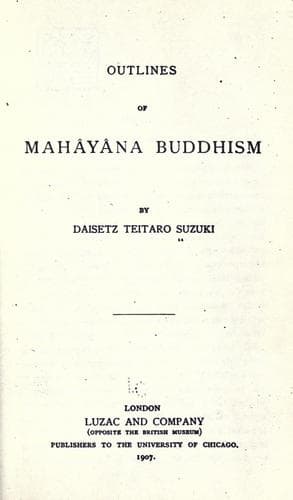
Outlines of Mahayana BuddhismSuzuki, Daisetz Teitaro
Religion
Outlines of Mahayana Buddhism
Suzuki, Daisetz Teitaro
Mahayana Buddhism -- Doctrines
As we cannot think that the essence of the external world to be other
than that of our own mind, that is to say, as we cannot think subject
and object to be different in their ultimate nature, our conclusion
naturally is that the same principle of Ignorance which gathers the
clouds of subjectivity, calls up the multitudinousness of phenomena in
the world-mind of Suchness. The universe in its entirety is an
infinite mind, and our limited mind with its transmarginal
consciousness is a microcosm. What the finite mind feels in its inmost
self, must also be what the cosmic mind feels; nay, we can go one step
further, and say that when the human mind enters the region lying
beyond the border of subjectivity and objectivity, it is in communion
with the heart of the universe, whose secrets are revealed here
without reserve. Therefore, Buddhism does not make any distinction
between knowing and being, enlightenment and Suchness. When the mind
is free from ignorance and no more clings to things particular, it is
said to be in harmony and even one with Suchness.
We must, however, remember that ignorance as the principle of
individuation and a spontaneous expression of Suchness, is no moral
evil. The awakening of subjectivity or the dawn of consciousness forms
part of the necessary cosmic process. The separation of subject and
object, or the appearance of a phenomenal world, is nothing but a
realisation {123} of the cosmic mind (Dharmakâya). As such Ignorance
performs an essential function in the evolution of the world-totality.
Ignorance is inherent in Buddhas as well as in all sentient beings.
Every one of us cannot help perceiving an external world (_viṣaya_)
and forming conceptions and reasoning and feeling and willing. We do
not see any moral fault here. If there is really anything morally
wrong, then we cannot do anything with it, we are utterly helpless
before it, for it is not our fault, but that of the cosmic soul from
which and in which we have our being.
Public-domain text, read in full here on John Shaqi.
Reviews
Reviews
No reviews yet
Be the first to share your thoughts on this work.
Elsewhere in the archive
Join the Discussion
Join the discussion
Sign in to leave a comment or review.
Sign InorCreate an account