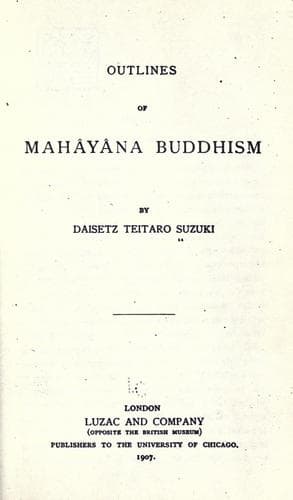
Outlines of Mahayana BuddhismSuzuki, Daisetz Teitaro
Religion
Outlines of Mahayana Buddhism
Suzuki, Daisetz Teitaro
Mahayana Buddhism -- Doctrines
Ignorance has produced everywhere a state of relativity and reciprocal
dependence. Birth is inseparably linked with death, congregation with
segregation, evolution with involution, attraction with repulsion, the
centripetal with the centrifugal force, the spring with the fall, the
tide with the ebb, joy with sorrow, God with Satan, Adam with Eve,
Buddha with Devadatta, etc., etc., _ad infinitum_. These are necessary
conditions of existence; and if existence is an evil, they must be
abolished, and with their abolition the very reason of existence is
abolished, which means absolute nothingness, an impossibility as long
as we exist. The work of ignorance in the world of conditional
Suchness is quite innocent, and Buddhists do not recognise any fault
in its existence, if not contaminated by confused subjectivity. Those
who speak of the curse of existence, or those who conceive Nirvâna to
be the abode of non-existence {124} and the happiness of absolute
annihilation, are considered by Buddhists to be unable to understand
the significance of Ignorance.
Is there then no fault to be found with Ignorance? Not in Ignorance
itself, but in our defiled attachment to it, that is, when we are
ignorant of Ignorance. It is wrong to cling to the dualism of subject
and object as final and act accordingly. It is wrong to take the work
of ignorance as ultimate and to forget the foundation on which it
stands. It is wrong, thinking that the awakening of consciousness
reveals the whole world, to ignore the existence of unseen realities.
In short, evils quickly follow our steps when we try to realise the
conclusions of ignorance without knowing its true relation to Suchness.
Egoism is the most fundamental of all errors and evils.
When we speak of ignorance as hindering the light of intelligence from
penetrating to the bottom of reality, we usually understand the term
ignorance not in the philosophical sense of principium individuum, but
in the sense of confused subjectivity, which conceives the work of
Ignorance as the final reality culminating in egoism. So, we might say
that while the principle of Ignorance is philosophically justified,
its unenlightened actualisation in our practical life is altogether
unwarranted and brings on us a series of dire calamities.
CHAPTER VI.
THE TATHÂGATA-GARBHA AND THE
ÂLAYA-VIJÑÂNA.
{125}
Public-domain text, read in full here on John Shaqi.
Reviews
Reviews
No reviews yet
Be the first to share your thoughts on this work.
Elsewhere in the archive
Join the Discussion
Join the discussion
Sign in to leave a comment or review.
Sign InorCreate an account