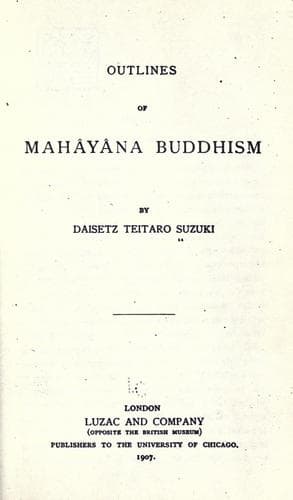
Outlines of Mahayana BuddhismSuzuki, Daisetz Teitaro
Religion
Outlines of Mahayana Buddhism
Suzuki, Daisetz Teitaro
Mahayana Buddhism -- Doctrines
Açvaghoṣa, the first Mahâyâna expounder known to us,--living about the
time of Christ,--used the term in his religio-philosophical book
called _Discourse on the Awakening of Faith in the Mahâyâna_[3] as
synonymous with Bhûtatathâtâ, or Dharmakâyâ,[4] the {8} highest
principle of Mahâyânism. He likened the recognition of, and faith in,
this highest being and principle into a conveyance which will carry us
safely across the tempestuous ocean of birth and death (_samsâra_) to
the eternal shore of Nirvâna.
Soon after him, however, the controversy between the two schools of
Buddhism, conservatives and progressionists as we might call them,
became more and more pronounced; and when it reached its climax which
was most probably in the times of Nâgârjuna and Âryadeva, i.e., a
few centuries after Açvaghoṣa, the progressive party ingeniously
invented the term Hînayâna in contrast to Mahâyâna, the latter
having been adopted by them as the watchword of their own school. The
Hînayânists and the Tîrthakas[5] then were sweepingly condemned by
the Mahâyânists as inadequate to achieve a universal salvation of
sentient beings.
_An Older Classification of Buddhists._
Before the distinction of Mahâyânists and Hînayânists became definite,
that is to say, at the time of Nâgârjuna or even before it, those
Buddhists who held a more progressive and broader view tried to
distinguish three yânas among the followers of the Buddha, viz.,
Bodhisattva-yâna, Pratyekabuddha-yâna, and Çrâvaka-yâna; yâna being
another name for class.
{9}
The Bodhisattva is that class of Buddhists who, believing in the Bodhi
(intelligence or wisdom), which is a reflection of the Dharmakâya in
the human soul, direct all their spiritual energy toward realising and
developing it for the sake of their fellow-creatures.
The Pratyekabuddha is a “solitary thinker” or a philosopher, who,
retiring into solitude and calmly contemplating on the evanescence of
worldly pleasures, endeavors to attain his own salvation, but remains
unconcerned with the sufferings of his fellow-beings. Religiously
considered, a Pratyekabuddha is cold, impassive, egotistic, and lacks
love for all mankind.
The Çrâvaka which means “hearer” is inferior in the estimate of
Mahâyânists even to the Pratyekabuddha, for he does not possess any
intellect that enables him to think independently and to find out by
himself the way to final salvation. Being endowed, however, with a
pious heart, he is willing to listen to the instructions of the Buddha,
to believe in him, to observe faithfully all the moral precepts given
by him, and rests fully contented within the narrow horizon of his
mediocre intellect.
To a further elucidation of Bodhisattvahood and its important bearings
in the Mahâyâna Buddhism, we devote a special chapter below. For
Mahâyânism is no more than the Buddhism of Bodhisattvas, while the
Pratyekabuddhas and the Çrâvakas are considered by Mahâyânists to be
adherents of Hînayânism.
{10}
Public-domain text, read in full here on John Shaqi.
Reviews
Reviews
No reviews yet
Be the first to share your thoughts on this work.
Join the Discussion
Join the discussion
Sign in to leave a comment or review.
Sign InorCreate an account