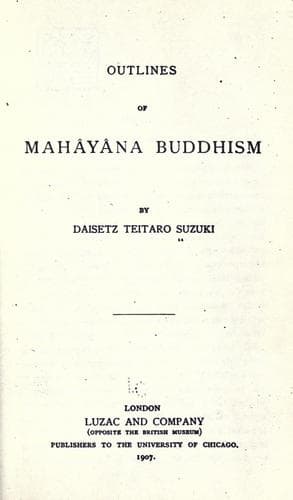
Outlines of Mahayana BuddhismSuzuki, Daisetz Teitaro
Religion
Outlines of Mahayana Buddhism
Suzuki, Daisetz Teitaro
Mahayana Buddhism -- Doctrines
So is the parallelism between the Manovijñâna, and Buddhi and Ahankâra.
Buddhi, intellect, is defined as _adhyavasâya_ (_Kârika_, 23), while
Ahankâra is interpreted as _abhimanas_ (_Kârika_, 24), which is
evidently self-consciousness. As to the exact meaning of _adhyavasâya_,
there is a divergence of opinion: “ascertainment,” “judgment,”
“determination,” “apprehension” are some of the English equivalents
chosen for it. But the inner signification of Buddhi is clear enough;
it indicates the awakening of knowledge, the dawn of rationality, the
first shedding of light on the dark recesses of unconsciousness; so
the commentators give as the synonyms _mati_ (understanding), _khyâti_
(cognition), _jñânam_, _prajñâ_, etc., the last two of these, which
mean knowledge or intelligence, being also technical terms of
Mahâyânism. And, as we have seen above, these senses are what the
Buddhists give to their Manovijñâna, save that the {139} latter in
addition has the faculty of discriminating between _teum_ and _meum_,
while in the Sâmkhya this is reserved for Ahankâra. Thus, here, too,
in place of the Sâmkhya dualism, we have the Buddhist unity.
Another point we have to take notice here in comparing the two great
Hindu religio-philosophical systems, is that the Sâmkhya philosophy
pluralises the Soul (_puruṣa_, _Kârika_, 18), while Buddhism
postulates one universal Citta or Âlaya. According to the followers
of Kapila, therefore, there must be as many souls as there are
individuals, and at every departure or advent of an individual there
must be assumed a corresponding soul passing away or coming into
existence, though we do not know its whence and whither. Buddhism, on
the other hand, denies the existence of any individual mind apart from
the All-Conserving Mind (_Âlaya_) which is universal. Individuality
first appears at the awakening of the Manovijñâna. The quintessence
of the Mind is Suchness and is not subject to the limitations of time
and space as well as the law of causation. But as soon as it asserts
itself in the world of particularisation, it negates itself thereby,
and, becoming specialised, gives rise to individual souls.[64]
CHAPTER VII.
THE THEORY OF NON-ATMAN OR NON-EGO.
{140}
/If/ I am requested to formulate the ground-principles of the
philosophy of Mahâyâna Buddhism, and, indeed, of all the schools of
Buddhism, I would suggest the following:
(1) All is momentary (_sarvam kṣanikam_).
(2) All is empty (_sarvam çûnyam_).
(3) All is without self (_sarvam anâtmam_).
(4) All is such as it is (_sarvam tathâtvam_).
These four tenets, as it were, are so closely interrelated that, stand
or fall, they all inevitably share one and the same fate together.
Whatever different views the various schools of Buddhism may hold on
points of minor importance, they all concur at least on these four
principal propositions.
Public-domain text, read in full here on John Shaqi.
Reviews
Reviews
No reviews yet
Be the first to share your thoughts on this work.
Elsewhere in the archive
Join the Discussion
Join the discussion
Sign in to leave a comment or review.
Sign InorCreate an account