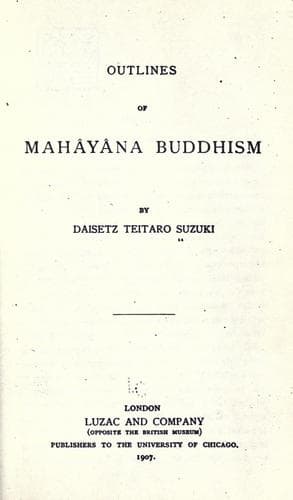
Outlines of Mahayana BuddhismSuzuki, Daisetz Teitaro
Religion
Outlines of Mahayana Buddhism
Suzuki, Daisetz Teitaro
Mahayana Buddhism -- Doctrines
Of these four propositions, the first, the second, and the fourth have
been elucidated above, more or less explicitly. If the existence of a
relative world is the work of ignorance and as such has no final
reality, it must be considered illusory and empty; though it does not
necessarily follow that on this account our life is not worth living.
We must not {141} confuse the moral value of existence with the
ontological problem of its phenomenality. It all depends on our
subjective attitude whether or not our world and life become full of
significance. When the illusiveness or phenomenality of individual
existences is granted and we use the world accordingly, that is, “as
not abusing it,” we escape the error and curse of egoism and take
things as they are presented to us, as reflecting the Dharma of
Suchness. We no more cling to forms of particularity as something
ultimate and absolutely real and as that in which lies the essence of
our life. We take them for such as they are, and recognise their
reality only in so far as they are considered a partial realisation of
Suchness, and do not go any further. Suchness, indeed, lies not hidden
_behind_ them, but exists immanently _in_ them. Things are empty and
illusory so long as they are particular things and are not thought of
in reference to the All that is Suchness and Reality.
From this, it logically follows that in this world of relativity all
is momentary, that nothing is permanent, so far as isolated, particular
existences are concerned. Even independently of the statement made
above, the doctrine of universal impermanency is an almost self-evident
truth experienced everywhere, and does not require any special
demonstration to prove its validity. The desire for immortality which
is so conspicuous and persistent in all the stages of development of
the religious consciousness that the very desire has been thought to
be the essence of all {142} religious systems, is the most conclusive
proof that things on this earth are in a constant flux of becoming,
and that there is nothing permanent or stationary in our individual
existences; if otherwise, people would never have sought for
immortality.
Public-domain text, read in full here on John Shaqi.
Reviews
Reviews
No reviews yet
Be the first to share your thoughts on this work.
Elsewhere in the archive
Join the Discussion
Join the discussion
Sign in to leave a comment or review.
Sign InorCreate an account