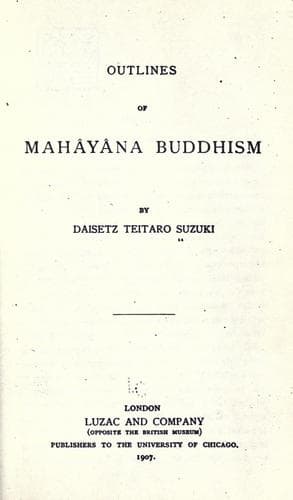
Outlines of Mahayana BuddhismSuzuki, Daisetz Teitaro
Religion
Outlines of Mahayana Buddhism
Suzuki, Daisetz Teitaro
Mahayana Buddhism -- Doctrines
If this be granted as a fact of our everyday experience, we naturally
ask: “Why are things so changeable? Why is life so fleeting? What is
it that makes things so mutable and transitory?” To this, the
Buddhist’s answer is: Because the universe is a resultant product of
many efficient forces that are acting according to different
karmas;--the destiny of those forces being that no one force or no one
set of forces can constantly be predominant over all the others, but
that when one has exhausted its potential karma, it is replaced by
another that has been steadily coming forward in the meantime. Hence
the universal cadence of birth and death, of the spring and the fall,
of the tide and the ebb, of integration and disintegration. Where
there is attraction, there is repulsion; where there is the
centripetal force, there is the centrifugal force. Because it is the
law of karma that at the very moment of birth the arms of death are
around the neck of life. The universe is nothing but a grand rhythmic
manifestation of certain forces working in conformity to their
predetermined laws; or, to use Buddhist terminology, this _lokadhâtu_
(material world) consists in a concatenation of _hetus_ (causes) and
_pratyayas_ (conditions) regulated by their karma. {143} If this were
not so, there would be either a certain fixed state of things in which
perfect equilibrium would be maintained, or an inexpressible confusion
of things of which no knowledge or experience would be possible. In
the former case, we should have universal stagnation and eternal
death; in the latter case, there would be no universe, no life,
nothing but absolute chaos. Therefore, so long as we have the world
before us, in which all the possible varieties of particularisation
are manifested it cannot be otherwise than in a state of constant
vicissitudes and therefore of universal transitoriness.
Now, the Buddhist argument for the theory of non-ego is this: If
individual existences are due to relations obtaining between diverse
forces, which act sometimes in unison with and sometimes in opposition
to one another as predetermined by their karma, they cannot be said to
have any transcendental agency behind them, which is a permanent unity
and absolute dictator. In other words, there is no âtman or ego-soul
behind our mental activities, and no thing-in-itself (_svabhâva_), so
to speak, behind each particular form of existence. This is called the
Buddhist theory of non-âtman or non-ego.
_Âtman._
Buddhists use the term “âtman” in two senses: first, in the sense of
personal ego,[65] and secondly, in {144} that of thing-in-itself,
perhaps, with a slight modification of its commonly accepted meaning.
Let us use the term “âtman” here in its first sense as equivalent to
_bhûtâtman_, for we are going first to treat of the doctrine of
non-ego, and later of that of no-thing-in-itself.
Public-domain text, read in full here on John Shaqi.
Reviews
Reviews
No reviews yet
Be the first to share your thoughts on this work.
Elsewhere in the archive
Join the Discussion
Join the discussion
Sign in to leave a comment or review.
Sign InorCreate an account