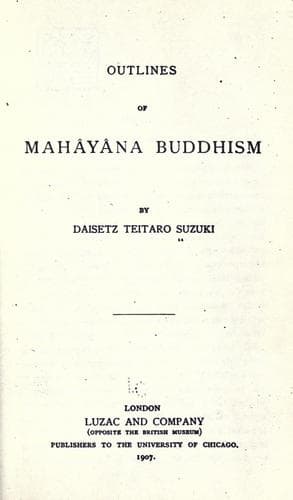
Outlines of Mahayana BuddhismSuzuki, Daisetz Teitaro
Religion
Outlines of Mahayana Buddhism
Suzuki, Daisetz Teitaro
Mahayana Buddhism -- Doctrines
The eight indefinite sanskâras are: 1. kâukṛtya (repentance), 2.
middha (sleep), 3. vitarka (inquiry), 4. vicâra (investigation), 5.
râga (excitement), 6. pratigha (wrath), 7. mâna (self-reliance), 8.
vicikitsâ (doubting).
The second grand category of sanskâra which is not included under
“mental” or “psychic,” comprises fourteen items as follows: 1. prâpti
(attainment), 2. aprâpti (non-attainment), 3. sabhâgatâ (grouping),
4 asanjñika (unconsciousness), 5. asanjñisamâpatti (unconscious
absorption in religious meditation), 6. nirodhasamâpatti
(annihilation-trance of a heretic), 7. jîvita (vitality), 8. jâti
(birth), 9. sthiti (existing), 10. jarâ (decadence), 11. anityatâ
(transitoriness), 12. nâmakâya (name), 13. padakâya (phrase), 14.
vyañjanakâya (sentence).
Now, to return to the main problem. The fifth skandha is called
_vijñâna_, commonly rendered consciousness, which, however, is not
quite correct. The vijñâna is intelligence or mentality, it is the
psychic power of discrimination, and in many cases it can be
translated by sense. There are, according to Hînayânists, six
vijñânas or senses: visual, auditory, olfactory, gustatory, tactual,
and cogitative; according {153} to Mahâyânism there are eight
vijñânas: the manovijñâna and the âlayavijñâna, being added to the
above six. This psychological phase of Mahâyâna philosophy is
principally worked out by the Yogâcâra school, whose leading thinkers
are Asanga and Vasubandhu.
_King Milinda and Nâgasena._
Buddhist literature, Northern as well as Southern, abounds with
expositions of the doctrine of non-ego, as it is one of the most
important foundation-stones on which the magnificent temple of
Buddhism is built. The dialogue[71] between King Milinda and
Nâgasena, among many others, is very interesting for various reasons
and full of suggestive thoughts, and we have the following discussion
of theirs concerning the problem of ego abstracted from the Dialogue.
At their first meeting the King asks Nâgasena, “How is your Reverence
known, and what is your name?”
To this the monk-philosopher replies: “I am known as Nâgasena, and it
is by that name that my brethren in the faith address me. But although
parents give such a name as Nâgasena, or Sûrasena, Vîrasena, or
Sîhasena, yet this Nâgasena and so on--is only a generally understood
term, a designation in common use. For there is no permanent self
involved in the matter.”
Being greatly surprised by this answer, the King {154} volleys upon
Nâgasena a series of questions as follows:
Public-domain text, read in full here on John Shaqi.
Reviews
Reviews
No reviews yet
Be the first to share your thoughts on this work.
Elsewhere in the archive
Join the Discussion
Join the discussion
Sign in to leave a comment or review.
Sign InorCreate an account