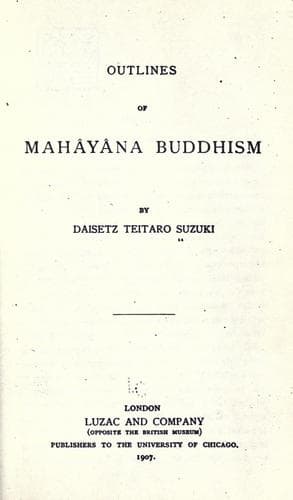
Outlines of Mahayana BuddhismSuzuki, Daisetz Teitaro
Religion
Outlines of Mahayana Buddhism
Suzuki, Daisetz Teitaro
Mahayana Buddhism -- Doctrines
“If there be no permanent self involved in the matter, who is it, pray,
who gives to you members of the Order your robes and food and lodging
and necessaries for the sick? Who is it who enjoys such things when
given? Who is it who lives a life of righteousness? Who is it who
devotes himself to meditation? Who is it who attains to the goal of
the Excellent Way, to the Nirvâna of Arhatship? And who is it who
destroys living creatures? who is it who takes what is not his own?
who is it who lives an evil life of worldly lusts, who speaks lies,
who drinks strong drink, who in a word commits any one of the five
sins which work out their bitter fruit even in this life? If that be
so, there is neither merit nor demerit; there is neither doer nor
cause of good or evil deeds; there is neither fruit nor result of good
or evil karma. If we are to think that were a man to kill you there
would be no murder,[72] then it follows that there are no real
masters or teachers in your Order, that your ordinations are void. You
tell me that your brethren in the Order are in the habit of addressing
you as Nâgasena. Now, what is that Nâgasena? Do you mean to say that
the hair is Nâgasena?”
This last query being denied by the Buddhist sage, the King asks: “Or
is it the nails, the skin, the flesh, the nerves, the bones, the
marrow, the kidneys, {155} the heart, the liver, the abdomen, the
spleen, the lungs, the larger intestines, the smaller intestines, the
faeces, the bile, the phlegm, the pus, the blood, the sweat, the fat,
the tears, the serum, the saliva, the mucus, the oil that lubricates
the joints, the urine, or the brain or any or all of these, that is
Nâgasena?
“Is it the material form that is Nâgasena, or the sensations, or the
ideas, or the confections (deeds), or the consciousness, that is
Nâgasena?”
To all these questions, the King, having received a uniform denial,
exclaims in excitement: “Then, thus, ask as I may, I can discover no
Nâgasena. Nâgasena is a mere empty sound. Who then is the Nâgasena
that we see before us?[73] It is a falsehood that your Reverence has
spoken, an untruth?”
Nâgasena does not give any direct answer, but quietly proposes some
counter-questions to the King. Ascertaining that he came in a carriage
to the Buddhist philosopher, he asks: “Is it the wheel, or the
framework, or the ropes, or the spokes of the wheels, or the goad,
that are the chariot?”
To this, the king says, “No,” and continues: “It is on account of its
having all these things that it {156} comes under the generally
understood term, the designation in common use, of ‘chariot.’”
“Very good,” says Nâgasena, “Your Majesty has rightly grasped the
meaning of ‘chariot.’ And just even so it is on account of all these
things you questioned me about the thirty-two kinds of organic matter
in a human body, and the five skandhas (constituent elements of being)
that I come under the generally-understood term, the designation in
common use, of ‘Nâgasena.’”
Public-domain text, read in full here on John Shaqi.
Reviews
Reviews
No reviews yet
Be the first to share your thoughts on this work.
Elsewhere in the archive
Join the Discussion
Join the discussion
Sign in to leave a comment or review.
Sign InorCreate an account