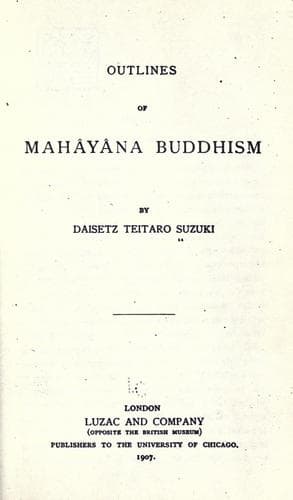
Outlines of Mahayana BuddhismSuzuki, Daisetz Teitaro
Religion
Outlines of Mahayana Buddhism
Suzuki, Daisetz Teitaro
Mahayana Buddhism -- Doctrines
Says the Buddha: “If the soul, as you say, exists in the relation
between the sense-organs (_indṛya_) and their respective sense-objects
(_viṣaya_), should we consider the soul as uniting and partaking the
natures of these two incongruous things, viṣaya and indṛya? If the
soul partakes something of each, it has no characteristics of its own.
If it unites the two natures, the distinction between subject and
object exists no more. ‘In the middle’ is an empty word; that is to
say, to conceive the soul as the relation between the indryas and the
viṣayas is to make it an airy nothing.”
The seventh and final hypothesis offered by Ânanda is that the soul
is the state of non-attachment, and that, therefore, it has no
particular locality in which it abides. But this is also mercilessly
attacked by the Buddha who declares: “Attachment presupposes the
existence of beings to which a mind-may be attached. {163} Now, should
we consider these things (_dharmas_) such as the world, space, land,
water, birds, beasts, etc. as existing or not existing? If the
external world does not exist, we cannot speak about non-attachment,
as there is nothing to attach from the first. If the external world
really is, how can we manage not to come in contact with it? When we
say that things are devoid of all characteristic marks, it amounts to
the declaration that they are non-existent. But they are not
non-existent, they must have certain characteristics that distinguish
themselves. Now, the external world has certainly some marks
(_lakṣana_) and it must by all means be considered as existing. There
then is no room for your theory of non-attachment.”
At this, Ânanda surrenders and the Buddha discloses his theory of
Dharmakâya, which we shall expound at some length in the chapter
specially devoted to it.
* * *
By way of a summary of the above, let me remark that the Buddhists do
not deny the existence of the so-called empirical ego in
contradistinction to the noumenal ego, which latter can be considered
to correspond to the Buddhist âtman. Vasubandhu in his treatise on
the Yogâcâra’s idealistic philosophy declares that the existence of
âtman and dharma is only hypothetical, provisional, apparent, and not
in any sense real and ultimate. To express this in modern terms, the
soul and the world, or subject and object, have only relative
existence, and no absolute reality can {164} be ascribed to them.
Psychologically speaking, every one of us has an ego or soul which
means the unity of consciousness; and physically, this world of
phenomena is real either as a manifestation of one energy or as a
composite of atoms or electrons, as is considered by physicists.
Public-domain text, read in full here on John Shaqi.
Reviews
Reviews
No reviews yet
Be the first to share your thoughts on this work.
Elsewhere in the archive
Join the Discussion
Join the discussion
Sign in to leave a comment or review.
Sign InorCreate an account