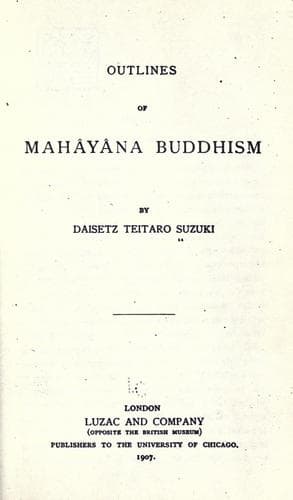
Outlines of Mahayana BuddhismSuzuki, Daisetz Teitaro
Religion
Outlines of Mahayana Buddhism
Suzuki, Daisetz Teitaro
Mahayana Buddhism -- Doctrines
To confine ourselves to the psychological question, what Buddhism most
emphatically insists on is the non-existence of a concrete,
individual, irreducible soul-substance, whose immortality is so much
coveted by most unenlightened people. Individuation is only relative
and not absolute. Buddhism knows how far the principle could safely
and consistently be carried out, and its followers will not forget
where to stop and destroy the wall, almost adamantine to some
religionists, of individualism. Absolute individualism, as the
Buddhists understand it, incapacitates us to follow the natural flow
of sympathy; to bathe in the eternal sunshine of divinity which not
only surrounds but penetrates us; to escape the curse of individual
immortality which is strangely so much sought after by some people; to
trace this mundane life to its fountainhead of which it drinks so
freely, yet quite unknowingly; to rise rejuvenated from the consuming
fire of Kâla (Chronos). To think that there is a mysterious something
behind the empirical ego and that this something comes out triumphantly
after the fashion of the immortal phœnix from the funeral pyre of
corporeality, is not Buddhistic.
What I would remark here in connection with this {165} problem of the
soul, is its relation to that of Âlayavijñâna, of which it is said
that the Buddha was very reluctant to talk, on account of its being
easily confounded with the notion of the ego. The Âlaya, as was
explained, is a sort of universal soul from which our individual
empirical souls are considered to have evolved. The Manas which is the
first offspring of the Âlaya is endowed with the faculty of
discrimination, and from the wrongful use of this faculty there arises
in the Manas the conception of the Âlaya as the ego,--the real
concrete soul-substratum.
The Âlaya, however, is not a particular phenomenon, for it is a state
of Suchness in its evolutionary disposition and has nothing in it yet
to suggest its concrete individuality. When the Manas finds out its
error and lifts the veil of Ignorance from the body of the Âlaya, it
soon becomes convinced of the ultimate nature of the soul, so called.
For the soul is not individual, but supra-individual.
_Âtman and the “Old Man.”_
Public-domain text, read in full here on John Shaqi.
Reviews
Reviews
No reviews yet
Be the first to share your thoughts on this work.
Elsewhere in the archive
Join the Discussion
Join the discussion
Sign in to leave a comment or review.
Sign InorCreate an account