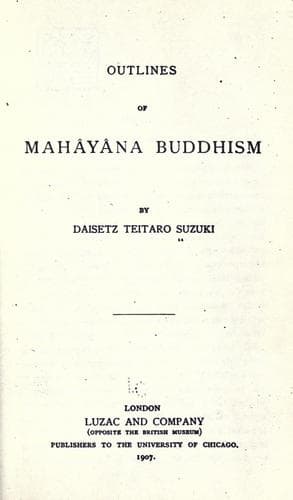
Outlines of Mahayana BuddhismSuzuki, Daisetz Teitaro
Religion
Outlines of Mahayana Buddhism
Suzuki, Daisetz Teitaro
Mahayana Buddhism -- Doctrines
When the Buddhists exclaim: “Put away your egoism, for the ego is an
empty notion, a mere word without reality,” some of our Christian
readers may think that if there is no ego, what will become of our
personality or individuality? Though this point will become clearer as
we proceed, let us remark here that what Buddhism understands by ego
or âtman may be considered to correspond in many respects to the
Christian notion of “flesh” or the {166} “old man,” which is the
source of all our sinful acts. Says Paul: “I am crucified with Christ;
nevertheless I live; yet not I, but Christ liveth in me: and the life
which I live now in the flesh I live by the faith of the Son of God,
who loved me and gave himself for me.” (Gal. ii, 20.) When this
passage is interpreted by the Buddhists, the “I” that was annihilated
through crucifixion, is our false notion of an ego-soul (_âtman_);
and the “I” that is living through the grace of God is the Bodhi, a
reflex in us of the Dharmakâya.
When Christians put the spirit and the flesh in contrast and advise us
to “walk in the spirit” and not to “fulfil the lust of the flesh,” it
must be said that they understand by the flesh our concrete, material
existence whose characteristic is predominantly individual, and by the
spirit, that which transcends particularity and egoism; for “love,
joy, peace, long-suffering, faith, meekness, temperance,” and suchlike
virtues are possible only when our egocentric, âtman-made desires are
utterly abnegated. Buddhism is more intellectual than Christianity or
Judaism and prefers philosophical terms which are better understood
than popular language which leads often to confusion. Compared with
the Buddhists’ conception of âtman, the “flesh” lacks in perspicuity
and exactitude, not to speak of its dualistic tendency which is
extremely offensive to the Buddhists.
{167}
_The Vedantic Conception._
Though the doctrine of non-âtman is pre-eminently Buddhistic, other
Hindu philosophers did not neglect to acknowledge its importance in
our religious life. Having grown in the same soil under similar
circumstances, the following passage which is taken from the
_Yogavâsistha_ (which is supposed to be a Vedantic work, Upaçama P.,
ch. LII, 31, 44) sounds almost like Buddhistic:
“I am absolute, I am the light of intelligence, I am free from the
defilement of egoism. O thou that art unreal! I am not bound by thee,
the seed of egoism.”[76]
Public-domain text, read in full here on John Shaqi.
Reviews
Reviews
No reviews yet
Be the first to share your thoughts on this work.
Elsewhere in the archive
Join the Discussion
Join the discussion
Sign in to leave a comment or review.
Sign InorCreate an account