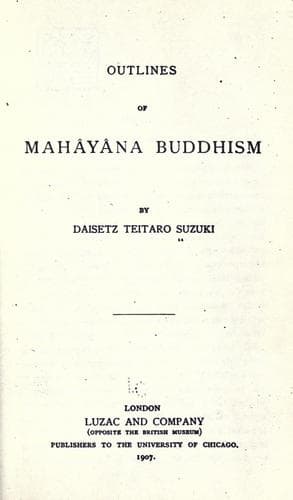
Outlines of Mahayana BuddhismSuzuki, Daisetz Teitaro
Religion
Outlines of Mahayana Buddhism
Suzuki, Daisetz Teitaro
Mahayana Buddhism -- Doctrines
“If seeing, hearing, feeling, etc. have no soul that exists prior to
them, they too have no existence as such. For how could _that_ exist
without _this_, and _this_ without _that_? Subject and object are
mutually conditioned. The soul as it is has no independent, individual
reality whatever. Therefore, the hypothesis that contends for the
existence of an ego-soul prior {170} to simultaneous with, or posterior
to, seeing, etc., is to be abandoned as fruitless, for the ego-soul
existeth not.”
_Non-âtman-ness of Things._
The word “âtman” is used by the Buddhists not only psychologically in
the sense of soul, self, or ego, but also ontologically in the sense
of substance or thing-in-itself or thinginess; and its existence in
this capacity is also strongly denied by them. For the same reason
that the existence of an individual ego-soul is untenable, they reject
the hypothesis of the permanent existence of an individual object as
such. As there is no transcendent agent in our soul-life, so there is
no real, eternal existence of individuals as individuals, but a system
of different attributes, which, when the force of karma is exhausted,
ceases to subsist. Individual existences cannot be real by their
inherent nature, but they are illusory, and will never remain permanent
as such; for they are constantly becoming, and have no selfhood though
they may so appear to our particularising senses on account of our
subjective ignorance. They are in reality cûnya and anâtman, they are
empty and void of âtman.
_Svabhâva._
The term “svabhâva” (self-essence or noumenon) is sometimes used by
the Mahâyânists in place of âtman, and they would say that all dharmas
have no self-essence, {171} _sarvam dharmam niḥsvabhâvam_, which is to
say, that all things in their phenomenal aspect are devoid of
individual selves, that it is only due to our ignorance that we believe
in the thinginess of things, whereas there is no such thing as svabhâva
or âtman or noumenon which resides in them. Svabhâva and âtman are thus
habitually used by Buddhists as quite synonymous.
Public-domain text, read in full here on John Shaqi.
Reviews
Reviews
No reviews yet
Be the first to share your thoughts on this work.
Elsewhere in the archive
Join the Discussion
Join the discussion
Sign in to leave a comment or review.
Sign InorCreate an account