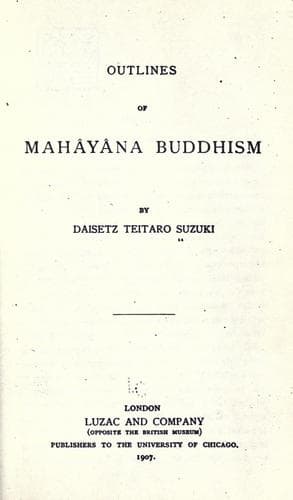
Outlines of Mahayana BuddhismSuzuki, Daisetz Teitaro
Religion
Outlines of Mahayana Buddhism
Suzuki, Daisetz Teitaro
Mahayana Buddhism -- Doctrines
What do they exactly understand by “svabhâva” whose existence is
denied in a particular object as perceived by our senses? This has
never been explicitly defined by the Mahâyânists, but they seem to
understand by svabhâva something concrete, individual, yet independent,
unconditional, and not subject to the law of causation
(_pratyayasamutpâda_). It, therefore, stands in opposition to
çûnyatâ, emptiness, as well as to conditionality. Inasmuch as all
beings are transient and empty in their inherent being, they cannot
logically be said to be in possession of self-essence which defies the
law of causation. All things are mutually conditioning and limiting,
and apart from their relativity they are non-existent and cannot be
known by us. Therefore, says Nâgârjuna, “If substance be different
from attribute, it is then beyond comprehension.”[80] For “a jag is
not to be known independent of matter et cetera, and matter in turn is
not to be known independent of ether et cetera.”[81] {172} As there
is no subject without object, so there is no substance without
attribute; for one is the condition for the other. Does self-essence
then exist in causation? No, “whatever is subject to conditionality,
is by its very nature tranquil and empty.” (_Pratîtya yad yad bhavati,
tat tac çântam svabhâvataḥ._) Whatever owes its existence to a
combination of causes and conditions is without self-essence, and
therefore it is tranquil (_çânta_), it is empty, it is unreal (_asat_),
and the ultimate nature of this universal emptiness is not within the
sphere of intellectual demonstrability, for the human understanding is
not capable of transcending its inherent limitations.
Says Pingalaka, a commentator of Nâgârjuna: “The cloth exists on
account of the thread; the matting is possible on account of the
rattan. If the thread had its own fixed, unchangeable self-essence, it
could not be made out of the flax. If the cloth had its own fixed,
unchangeable self-essence, it could not be made from the thread. But
as in point of fact the cloth comes from the thread and the thread
from the flax, it must be said that the thread as well as the cloth
had no fixed, unchangeable self-essence. It is just like the relation
that obtains between the burning and the burned. They are brought
together under certain conditions, and thus there takes place a
phenomenon called burning. The burning and the burned, each has no
reality of its own. For when one is absent the other is put out of
existence. It is so with all things in this world, they are all empty,
{173} without self, without absolute existence, they are like the
will-o’-the-wisp.”[82]
_The Real Significance of Emptiness._
Public-domain text, read in full here on John Shaqi.
Reviews
Reviews
No reviews yet
Be the first to share your thoughts on this work.
Elsewhere in the archive
Join the Discussion
Join the discussion
Sign in to leave a comment or review.
Sign InorCreate an account