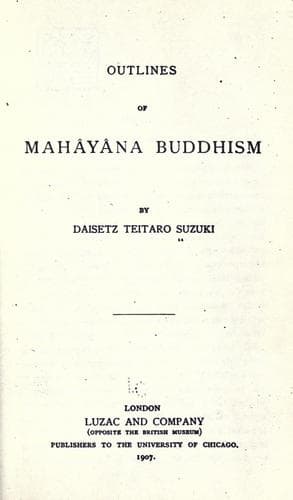
Outlines of Mahayana BuddhismSuzuki, Daisetz Teitaro
Religion
Outlines of Mahayana Buddhism
Suzuki, Daisetz Teitaro
Mahayana Buddhism -- Doctrines
“When you negate the doctrine of emptiness, the law of universal
causation, you negate the possibility of this phenomenal world. When
the doctrine of emptiness is negated, there remains nothing that ought
to be done; and a thing is called done which is not yet accomplished;
and he is said to be a doer who has {179} not done anything whatever.
If there were such a thing as self-essence, the multitudinousness of
things must be regarded as uncreated and imperishable and eternally
existing which is tantamount to eternal nothingness.
“If there were no emptiness there would be no attainment of what has
not yet been attained, nor would there be the annihilation of pain,
nor the extinction of all the passions (_sarvakleça_).
“Therefore, it is taught by the Buddha that those who recognise the
law of universal causation, recognise the Buddha as well as Suffering,
Accumulation, Cessation, and the Path.”
* * *
The Mahâyânistic doctrines thus formulated and transmitted down to
the present days are: There is no such thing as the ego; mentation is
produced by the co-ordination of various vijñânas or senses.
Individual existences have no selfhood or self-essence or reality, for
they are but an aggregate of certain qualities sustained by efficient
karma. The world of particulars is the work of Ignorance as declared
by Buddha in his Formula of Dependence (Twelve Nidânas). When this
veil of Mâya is uplifted, the universal light of Dharmakâya shines in
all its magnificence. Individual existences then as such lose their
significance and become sublimated and ennobled in the oneness of
Dharmakâya. Egoistic prejudices are forever vanquished, and the aim of
our lives is no more the {180} gratification of selfish cravings, but
the glorification of Dharma as it works its own way through the
multitudinousness of things. The self does not stand any more in a
state of isolation (which is an illusion), it is absorbed in the
universal body of Dharma, it recognises itself in other selves animate
as well as inanimate, and all things are in Nirvâna. When we reach
this state of ideal enlightenment, we are said to have realised the
Buddhist life.
CHAPTER VIII.
KARMA.
{181}
_Definition._
Public-domain text, read in full here on John Shaqi.
Reviews
Reviews
No reviews yet
Be the first to share your thoughts on this work.
Elsewhere in the archive
Join the Discussion
Join the discussion
Sign in to leave a comment or review.
Sign InorCreate an account