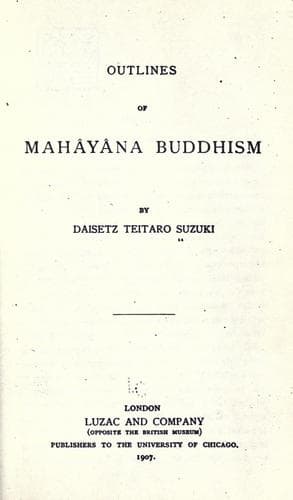
Outlines of Mahayana BuddhismSuzuki, Daisetz Teitaro
Religion
Outlines of Mahayana Buddhism
Suzuki, Daisetz Teitaro
Mahayana Buddhism -- Doctrines
“If there is really self-essence, Suffering could not {177} be
recognised now, as it had not been recognised, for self-essence as
such must remain forever the same. [That is to say, enlightened minds,
through the teaching of Buddha, now recognise the existence of
Suffering, though they did not recognise it when they were still
uninitiated. If things were all in a fixed, self-determining state on
account of their self-essence, it would be impossible for those
enlightened men to discover what they had never observed before. The
recognition of the Fourfold Noble Truth is only possible when this
phenomenal world is in a state of constant becoming, that is, when it
is empty as it really is.]
“As it is with the recognition of Suffering, so it is with the
stoppage of Accumulation, the attainment of Cessation, the realisation
of Path as well as with the four states of saintliness.
“If, on account of self-essence, the four states of saintliness were
unattainable before, how could they be realised now, still upholding
the hypothesis of self-essence? [But we can attain to saintliness as a
matter of fact, for there are many holy men who through their
spiritual discipline have emerged from their former life of ignorance
and darkness. If everything had its own self-essence which makes it
impossible to transform from one state to another, how could a person
desire to ascend, if he ever so desire, higher and higher on the scale
of existence?]
“If there were no four states of saintliness (_catvâri phalâni_), then
there would be no aspirants for it. {178} And if there were no eight
wise men (_puruṣapuñgala_), there could exist no Sangha.
“Again, when there could not be the Fourfold Noble Truth, the Law
would be impossible, and without the Sangha and the Law how could the
Buddha exist? You might say: ‘A Buddha does not exist on account of
wisdom (_Bodhi_), nor does wisdom exist on account of the Buddha.’ But
if a man did not have Buddha-essence [that is, Bodhi] he could not
hope to attain to Buddhahood, however strenuously he might exert
himself in the ways of Bodhisattva.
“Further, if all is not empty but has self-essence, [i.e. if all is in
a fixed, unchangeable state of sameness], how could there be any
doing? How could there be good and evil? If you maintain that there is
an effect (_phala_) which does not come from a cause good or evil,
[which is the practical conclusion of the hypothesis of self-essence],
then it means that retribution is independent of our deed, good or
evil. [But is this justified by our experience?]
“If it must then be admitted that our deed good or evil becomes the
cause of retribution, retribution must be said to come from our deed,
good or evil; then how could we say there is no emptiness?
Public-domain text, read in full here on John Shaqi.
Reviews
Reviews
No reviews yet
Be the first to share your thoughts on this work.
Elsewhere in the archive
Join the Discussion
Join the discussion
Sign in to leave a comment or review.
Sign InorCreate an account