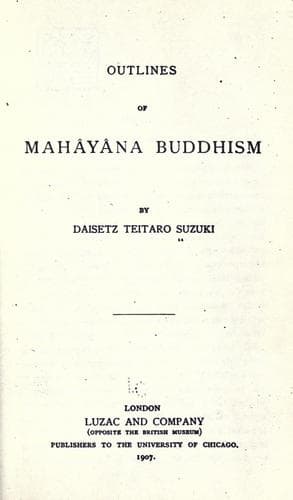
Outlines of Mahayana BuddhismSuzuki, Daisetz Teitaro
Religion
Outlines of Mahayana Buddhism
Suzuki, Daisetz Teitaro
Mahayana Buddhism -- Doctrines
The Buddhist conception of karma briefly stated is this: Any act, good
or evil, once committed and conceived, never vanishes like a bubble in
water, but lives, potentially or actively as the case may be, in the
world of minds and deeds. This mysterious moral energy, so to speak,
is embodied in and emanates from every act and thought, for it does
not matter whether it is actually performed, or merely conceived in
the mind. When the time comes, it is sure to germinate and grow with
all its vitality. Says Buddha:
“Karma even after the lapse of a hundred kalpas,
Will not be lost nor destroyed;
As soon as all the necessary conditions are ready,
Its fruit is sure to ripe.”[85]
{184}
Again,
“Whatever a man does, the same he in himself will find,
The good man, good: and evil he that evil has designed;
And so our deeds are all like seeds, and bring forth fruit in kind.”[86]
A grain of wheat, it is said, which was accidentally preserved in good
condition in a tomb more than a thousand years old, did not lose its
germinating energy, and, when planted with proper care, it actually
started to sprout. So with karma, it is endowed with an enormous
vitality, nay, it is even immortal. However remote the time of their
commission might have been, the karma of our deeds never dies; it must
work out its own destiny at whatever cost, if not overcome by some
counteracting force. The law of karma is irrefragable.
The irrefragability of karma means that the law of causation is
supreme in our moral sphere just as much as in the physical, that life
consists in a concatenation of causes and effects regulated by the
principle of karma, that nothing in the life of an individual or a
nation or a race happens without due cause and sufficient reason, that
is, without previous karma. The Buddhists, therefore, do not believe
in any special act of grace or revelation in our religious realm and
moral life. The idea of deus ex machina is banned in Buddhism. Whatever
is suffered or enjoyed morally in our present life is due to the karma,
accumulated {185} since the beginning of life on earth. Nothing sown,
nothing reaped.
Whatever has been done leaves an ineffable mark in the individual’s
life and even in that of the universe; and this mark will never be
erased save by sheer exhaustion of the karma or by the interruption of
an overwhelming counter-karma. In case the karma of an act is not
actualised during one’s own life-time, it will in that of one’s
successors, who may be physical or spiritual. Not only “the evil that
men do lives after them,” but also the good, for it will not be
“interred with their bones,” as vulgar minds imagine. We read in the
_Samyukta Nikâya_, III, 1-4:
“Assailed by death, in life’s last throes,
At quitting of this human state,
What is it one can call his own?
What with him take as he goes hence?
What is it follows after him,
And like a shadow ne’er departs?
Public-domain text, read in full here on John Shaqi.
Reviews
Reviews
No reviews yet
Be the first to share your thoughts on this work.
Elsewhere in the archive
Join the Discussion
Join the discussion
Sign in to leave a comment or review.
Sign InorCreate an account