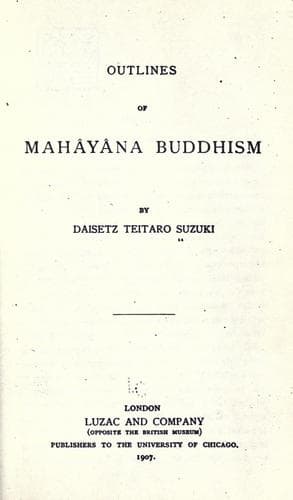
Outlines of Mahayana BuddhismSuzuki, Daisetz Teitaro
Religion
Outlines of Mahayana Buddhism
Suzuki, Daisetz Teitaro
Mahayana Buddhism -- Doctrines
“His good deeds and his wickedness,
Whate’er a mortal does while here;
’Tis this that he can call his own,
This with him take as he goes hence.
This is what follows after him,
And like a shadow ne’er departs.
“Let all, then, noble deeds perform,
A treasure-store for future weal;
For merit gained this life within,
Will yield a blessing in the next.”[87]
{186}
In accordance with this karmaic preservation, Buddhists do not expect
to have their sins expatiated by other innocent people so long as
their own hearts remain unsoftened as ever. But when the all-embracing
love of Buddhas for all sentient beings kindles even the smallest
spark of repentance and enlightenment in the heart of a sinner, and
when this ever-vacillating light grows to its full magnitude under
propitious conditions, the sinner gets fully awakened from the evil
karma of eons, and enters, free from all curses, into the eternity of
Nirvâna.
_Karma and Social Injustice._
The doctrine of karma is very frequently utilised by some Buddhists to
explain a state of things which must be considered cases of social
injustice.
There are some people who are born rich and noble and destined to
enjoy all forms of earthly happiness and all the advantages of social
life, though they have done nothing that justifies them in luxuriating
in such a fashion any more than their poor neighbors. These people,
however, are declared by some pseudo-Buddhists to be merely harvesting
the crops of good karma they had prepared in their former lives. On
the other hand, the poor, needy, and low that are struggling to eke
out a mere existence in spite of their moral rectitude and honest
industry, are considered to be suffering the evil karma which had been
accumulated during their previous lives. The law of moral retribution
is never {187} suspended, as they reason, on account of the changes
which may take place in a mortal being. An act, good or evil, once
performed, will not be lost in the eternal succession and interaction
of incidents, but will certainly find the sufferer of its due
consequence, and it does not matter whether the actor has gone through
the vicissitudes of birth and death. For the Buddhist conception of
individual identity is not that of personal continuity, but of karmaic
conservation. Whatever deeds we may commit, they invariably bear their
legitimate fruit and follow us even after death. Therefore, if the
rich and noble neglect to do their duties or abandon themselves to the
enjoyment of sensual pleasures, then they are sure in their future
births, if not in their present life, to gather the crops they have
thus unwittingly prepared for themselves. The poor, however hard their
lot in this life, can claim their rightful rewards, if they do not get
despaired of their present sufferings and give themselves up to
temptations, but dutifully continue to do things good and meritorious.
Because as their present fate is the result of their former deeds, so
Public-domain text, read in full here on John Shaqi.
Reviews
Reviews
No reviews yet
Be the first to share your thoughts on this work.
Elsewhere in the archive
Join the Discussion
Join the discussion
Sign in to leave a comment or review.
Sign InorCreate an account