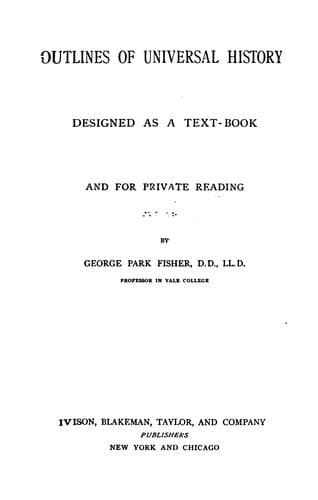
Outlines of Universal History, Designed as a Text-book and for Private ReadingFisher, George Park
History
Outlines of Universal History, Designed as a Text-book and for Private Reading
Fisher, George Park
World history
LATER SCHOOLS: THE CYNICS.--The impulse given by Socrates gave rise to
still other schools of philosophers. _Aristippus_ of Cyrene
(about 380 B.C.) founded a sect which held that happiness is the
chief end, the goal of rational effort. _Antisthenes_, who was
born 422 B.C., and especially _Diogenes_, went to the opposite
extreme, and founded the school of _Cynics_, who looked with
disdain, not only on luxuries, but on the ordinary comforts of life,
and inured themselves to do without them. Their manners were often as
savage as their mode of living.
HISTORICAL WRITINGS.--The three principal historical writers were
_Herodotus_ (c. 484-0.425 B.C.), the charming but uncritical
chronicler of what he heard and saw, by whom the interference of the
gods in human affairs is devoutly credited; _Thucydides_, who
himself took part in the Peloponnesian war, the history of which he
wrote with a candor, a profound perception of character, an insight
into the causes of events, a skill in arrangement, and a condensation
and eloquence of style, which are truly admirable; and
_Xenophon_, an author characterized by naturalness, simplicity,
and a religious spirit.
GREEK LIFE.--It will be convenient to bring together here some
features of Greek life, (1) _Public Buildings and
Dwellings_. The Greeks almost always preferred to live in
cities. These grew up about an _Acropolis_, which was a fort on
a hill, generally a steep crag. This was a place of refuge, and the
site of the oldest temple. It became often, therefore, a sacred
place from which private dwellings were excluded. At the nearest
harbor, there would be a seaport town. The _Piraeus_ was more
than four miles from Athens,--a mile farther than the nearest shore,
but was chosen as being an excellent harbor. Sparta, alone, had no
citadel,--the access from the plain being easily defended,--and no
walls. The attractive buildings in a Greek town were the public
edifices. Private houses, as to the exterior, were very plain, with
flat roofs, with few stories, and low. Towards the street "the house
looked like a dead wall with a strong door in it," It was built
round an open court: in the case of the best houses, round two
courts,--one bordered by apartments for the men, the other with the
rooms for women. Bedrooms and sitting-rooms were small, admitting
but little light. Fresco-painting on the walls and ceilings came to
be common. The furniture of the house was plain and simple, but
graceful and elegant in form. The poorer classes slept on skins; the
richer, on woolen mattresses laid on girths. The Greeks lived so
much in the open air that they took less pains with their
dwellings. The public buildings were costly and substantially
built. (2) _Meals, Gymnastics, etc._ The Greeks rose
early. There are no notices of a morning bath. The first meal was
light. It was succeeded, as was the custom at Rome, by calls on
friends.
Public-domain text, read in full here on John Shaqi.
Reviews
Reviews
No reviews yet
Be the first to share your thoughts on this work.
Elsewhere in the archive
Join the Discussion
Join the discussion
Sign in to leave a comment or review.
Sign InorCreate an account