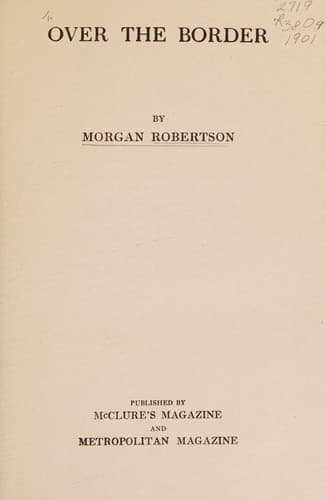
American fiction -- 20th century; Short stories, American
He did not jump. With his hands to his nostrils he shuffled forward
toward the monkey-rail that overlooked the main deck, halting at
moments, only to shuffle again. He turned around once and took a
few steps backward, then wheeled suddenly and resumed his shuffling
advance. I called again and again for him to jump, and Grace joined
me in pleading screams, while I heard the captain calling from the
other side. But to no avail; the god that he worshiped was calling the
louder. He staggered now, reached the rail, and with arms extended as
though in supplication, plunged into the inferno beneath.
Only once since then has anyone spoken of him to me. It was the gray
old skipper, who, after our rescue, wanted to set me right.
"You thought he fired the ship," he said, "for he told me of your
suspicions, and felt badly. But he did not. It was all my fault, for I
should have calked the ship at Hongkong. That three-day gale that we
met let the water down on the jute. It was spontaneous combustion."
But, in mercy to each other, Grace and I never mention his name.
THE BABY
It was Dartmoor who saw the chance. He was the son of a wealthy father,
and perhaps the one man of that medical class to feel equal to the
experiments given up by the old professor.
Physically, Dartmoor was exceptionally favored by nature, possessing
one of the most winning personalities I have ever met, and the face and
figure of a Greek god. And to this was added a mental development that
was almost abnormal in its completeness. I had gone through school with
him, and never saw him studying. He seemed to learn his lessons by a
few glances at the page of a book.
He had courage of a high order, but never had a fight in his life, for
he could make an adversary surrender without a fight. He could win
any girl for sweetheart, or any boy for friend. He had his enemies,
carefully chosen by himself, but when he so decided he would make these
enemies his friends. I had been one.
Shortly after our diplomas were given us, Dartmoor secured legal
possession of the freak, with a history of the case. The history was
simple; its mother, a poor immigrant, had died at its birth, and its
father was unknown.
The professor, a visiting physician of the hospital at the time, had
taken it into his sanitarium and cared for it; but beyond keeping it
alive had not helped it. It was a man that had never been conscious--a
human being born without the five senses.
Dartmoor erected a pavilion on his grounds, installed in it the freak,
together with the apparatus for massage and exercise, and gave himself
up to the study of his charge. He had me around once to witness the
experiments, but I was not enthusiastic.
The creature, who was about as old as Dartmoor and myself, lay in
a reclining posture on the exercising frame, staring vacantly with
wide-open, blue eyes. He was full grown, but with the features of an
infant--pudgy nose and pursed-up lips.
Public-domain text, read in full here on John Shaqi.
Reviews
Reviews
No reviews yet
Be the first to share your thoughts on this work.
Join the Discussion
Join the discussion
Sign in to leave a comment or review.
Sign InorCreate an account