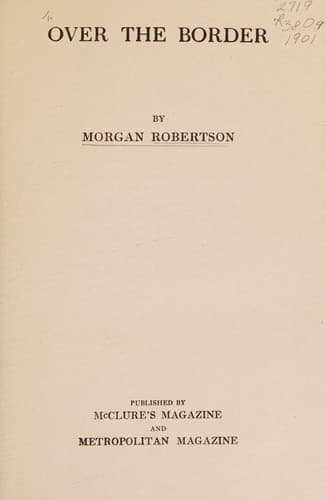
American fiction -- 20th century; Short stories, American
In my later capacity of visiting physician to that hospital I often
met young Dunbar, the scrub-woman's boy, as he progressed through the
ailments and accidents of childhood; and as family physician to the
wealthy Lance family I as often met their pampered youngster. After a
few years I noticed that if anything was wrong with one, something--not
necessarily the same thing--happened to the other. For instance,
young Dunbar broke his arm at the time young Lance had the measles.
The latter sprained his wrist, and the former came to the free clinic
the same day with a black eye, acquired in a fight. I called this
coincidence for a while, until both mothers died at the same hour,
of the same disease. Then I recalled that I, who had been present
at that other momentous event in their widely divergent lives, was
now the useless physician to each. I began to take notes, but never
investigated the lives of the mothers; my studies and speculations were
concerned with the lives of the sons. And I first learned that since
birth they had never met.
Each in his own environment, these two boys grew up, as different in
physique, mentality, and morals as can be imagined. At sixteen their
characters were shaped, and at this age I invoiced their attributes.
Each was what the other was not. Dunbar was a tough, Lance a gentleman;
but Dunbar possessed physical courage of the highest order, while
Lance, up to this period in his life, had never voluntarily placed
himself in the way of pain or punishment. He would run from an angry
goose or girl playmate. On the other hand, he possessed moral courage,
while Dunbar was a moral coward. Lance proudly bore himself through a
storm of boyish ridicule when caught playing with dolls and toy-houses,
while Dunbar hid himself in shame because of defeat at the hands of a
larger, heavier boy. Lance was truthful, polite, and with a high sense
of honor and justice; Dunbar a liar, a bully, and a bad example. His
associates were the worst in the town, and when there came the time
that my safe was robbed, and the loot was found upon Dunbar, I could
not have saved him, even though I had believed him innocent. It was
simply a case of the People against Dunbar, and I was prosecuting
witness.
Others had robbed me, and Dunbar, unthinkingly, had held the goods
until arrested. I could not prove this at the time, and so Dunbar
was convicted. But, as an incident in this story, on the day that
he entered prison to begin a four-years' sentence, Lance, the most
effeminate boy I had known in my experience, entered the Naval Academy
at Annapolis, there to begin a four-year tutelage in a profession where
the most masculine attributes are required.
Public-domain text, read in full here on John Shaqi.
Reviews
Reviews
No reviews yet
Be the first to share your thoughts on this work.
Join the Discussion
Join the discussion
Sign in to leave a comment or review.
Sign InorCreate an account