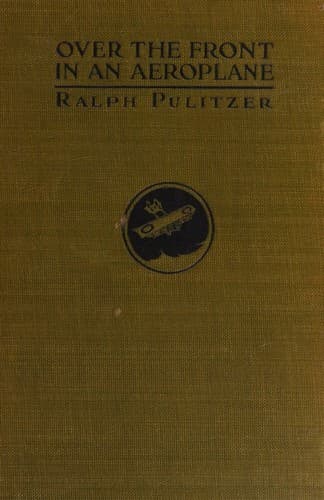
Over the Front in an Aeroplane, and Scenes Inside the French and Flemish TrenchesPulitzer, Ralph
History
Over the Front in an Aeroplane, and Scenes Inside the French and Flemish Trenches
Pulitzer, Ralph
World War, 1914-1918 -- Personal narratives
I looked through the next slit, through a spider's web of barbed wire,
between stunted black posts, across two hundred yards of green grass
and wild flowers, at another tangle of posts and barbed wire with a
narrow furrow of white chalky soil running along just behind it--the
German trenches.
Not a living thing was in sight in the sunny loneliness. There was
silence except for the crack, crack, crack of striking bullets from
inaudible German rifles. I looked back at the face of the "guetteur,"
the watcher. His eyes, fixed on the narrow white line, were puckered
with intentness, but his lips were parted in an easy, good-humored
smile, brightening a face young, clean-cut, alert, calm and very
patient.
He seemed to symbolize the spirit of the new France, the France of
endurance, of determination, of buoyancy, of patience, the stoic France
that can keep silent and motionless, the France that can stand in the
darkness undismayed, watching and waiting till the moment comes to leap
up and out into the light.
Early that morning, from the window of a château on the edge of a
high plateau, a young staff-officer had shown me the great plain of
Champagne stretching away to the low hills on the horizon. Miles away
lay Rheims, made to seem squatty by the cathedral which towered in its
midst.
Across the green fields of the panorama, over swelling hills,
disappearing into dark woods, reappearing at the other end, I saw two
tiny lines of white like the aimless tracing of a child's slate-pencil
on a slate. They ran on across the landscape, now drawn boldly forward,
now swerving with indecision, now zigzagging with perplexity. Sometimes
the child's pencil had slipped and made short little lines at right
angles. Sometimes the pencil had made three or four short starts
parallel with each other before it finally got under way. Sometimes
it had made a regular little maze of lines. But always the two white
scratchings on the slate were drawn on and on till, wavering but always
close abreast, the trenches of the two armies disappeared into the far
distance.
Through powerful glasses the officer showed me little puffs of smoke
floating up from the sunny, silent, peaceful landscape. They were from
the exploding shells. To the right I saw a high cloud of smoke rising
lazily into the air out of some woods. It was a house in the German
lines fired by French shells. And, though the little puffs of smoke
were only here and there on the landscape, everywhere I could see
through the glasses the microscopic figures of peasants working busily
in their fields, bringing in the harvest. Many were soldiers helping
out, but very many were old men, boys and women. Again the scene seemed
symbolical.
Behind the soldier watching in the bomb-proof were the innumerable tiny
plodding figures, undaunted by the abrupt little puffs of smoke, doing
their patient share toward bringing in the harvest.
Public-domain text, read in full here on John Shaqi.
Reviews
Reviews
No reviews yet
Be the first to share your thoughts on this work.
Join the Discussion
Join the discussion
Sign in to leave a comment or review.
Sign InorCreate an account