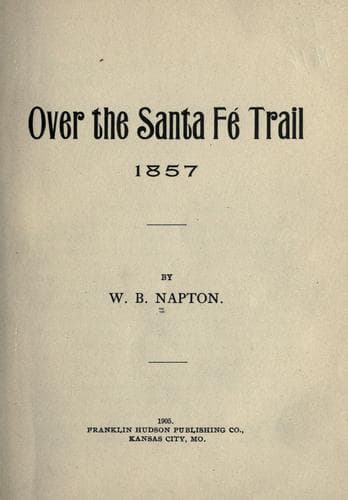
Over the Santa Fé Trail, 1857Napton, William Barclay
History
Over the Santa Fé Trail, 1857
Napton, William Barclay
Santa Fe National Historic Trail
“Jim Crow” was then about twenty-five, not over medium height, but
strong, athletic and wiry, and had a pretty well established reputation
as a fighter among the frontiersmen. He had killed a lawyer named
Moore, who lived at Leavenworth, in the Noland hotel at Independence.
After the Civil War he killed two other men at Independence, and he
himself was eventually killed in a fight with the Independence town
marshal. But I found “Jim Crow” a kind and considerate friend, jovial
and good natured generally, but subject to violent fits of anger, and
when angry, a very dangerous man. One night on the “trail,” while he
and I were riding some distance ahead of the train, amid the solitude
of the darkness and the vast plains, the conversation drifted into
a confidential vein. He recalled the killing of Moore, saying he
regretted it beyond measure; that the affair had haunted him day and
night; that he would willingly give up all that he owned or expected
to acquire to be relieved of the anguish and trouble and remorse the
act had caused him. But he was possessed of the kind of courage and
combativeness which never suggested the avoidance of a fight then or
afterward.
Kansas City was even then, in 1857, an aspiring town. For a month
or two in the spring the levee was covered with wagons and teams,
and sometimes four or five steamboats were at the wharf discharging
freight. General John W. Reid had recently bought forty acres, the
northwest corner of which is now the intersection of Broadway and
Twelfth street, for $2,000. The land was covered with timber, which he
cut into cord wood and sold to the steamboats for about enough to pay
for the land.
There were no streets, and only one road from the levee, leaving the
river front at Grand avenue, running obliquely across to Main street
and back again to Grand avenue, in McGee’s addition. Colonel Milton
McGee had taken down his fences and laid off his cornfields into lots.
The work cattle and wagons were collected and a camp established,
about the first of May, on the high, rolling prairie near the Santa
Fé trail, three miles southwest of Westport. The wagons were heavy,
cumbrous affairs with long deep beds, covered with sheets of heavy
cotton cloth, supported by bows. A man six feet high could stand erect
in one of them, and they were designed to hold a load of seven or eight
thousand pounds of merchandise each. Those in our train were made by
Hiram Young, a free negro at Independence, and they were considered
as good as any except those with iron axles. The freight consisted of
merchandise for the trade in New Mexico. Two of the wagons were loaded
with imported champagne for Colonel St. Vrain of Las Vegas and Mora.
Public-domain text, read in full here on John Shaqi.
Reviews
Reviews
No reviews yet
Be the first to share your thoughts on this work.
Join the Discussion
Join the discussion
Sign in to leave a comment or review.
Sign InorCreate an account