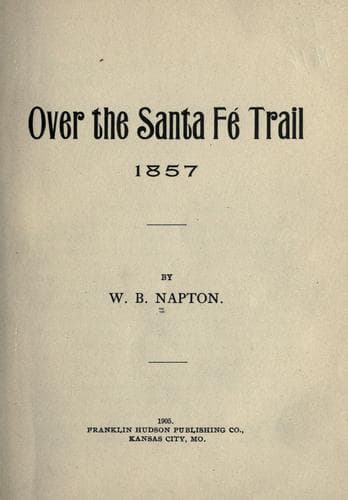
Over the Santa Fé Trail, 1857Napton, William Barclay
History
Over the Santa Fé Trail, 1857
Napton, William Barclay
Santa Fe National Historic Trail
The passengers formed a motley congregation. The two Indian agents,
their clerks and attachés, the agents, trappers and voyageurs of the
fur companies, mostly Canadian Frenchmen intermixed with Indians; a
few, however, were native Americans, a young English sportsman, Lace,
and his traveling companion from Liverpool, going up to the mountains
to kill big game. A young gentleman, Mr. Holbrook from New England, who
had just graduated at Harvard and was traveling for health, Carl Wimar,
an artist of St. Louis whose object was to get pictures of the Indians,
and a young man of great genius and promise in his profession, a
captain, two pilots, two engineers, two cooks, cabin-boys, etc., twenty
regular deck hands and, in addition to these, about seventy-five stout
laboring men to cut wood to supply fuel for the boat’s furnaces after
we had gotten up above the settlements.
We commenced cutting wood soon after passing Omaha, although we found
occasional piles of wood already cut on the river bank above Sioux
City, Iowa.
There were no female passengers and the boat had been stripped of
carpets, mirrors, etc.
Colonel Redfield was a staid, straight-laced gentleman from the East,
while Colonel Vaughn was a jolly frolicsome fellow of sixty-five years,
who had been thoroughly enjoying western life among the Indians on the
upper Missouri for many years, and no matter how late at night the bar
was patronized, the following morning, when one would enquire as to the
state of his health, he would answer with inimitable gusto, “Erect on
my pasterns, bold and vigorous.”
The fur company men were nearly all Canadian Frenchmen, some of them
having a greater or less degree of Indian blood in their veins. These
people had come down from their trading posts, starting just as soon
as the ice broke up in the river, on keel or flat-boats, bringing
along some furs and peltries, and had reached St. Louis in time to
spend a week or two there. Having settled with the fur companies at
headquarters in the city, the remainder of their limited contact with
civilization would be spent in seeing the sights of the city.
These fur traders, trappers and voyageurs formed a class now extinct in
the United States, a remnant of them yet remaining perhaps in British
America. The boat made no landings except for fuel, until we reached
the reservations of the Omahas and Winnebagoes in Nebraska.
Public-domain text, read in full here on John Shaqi.
Reviews
Reviews
No reviews yet
Be the first to share your thoughts on this work.
Join the Discussion
Join the discussion
Sign in to leave a comment or review.
Sign InorCreate an account