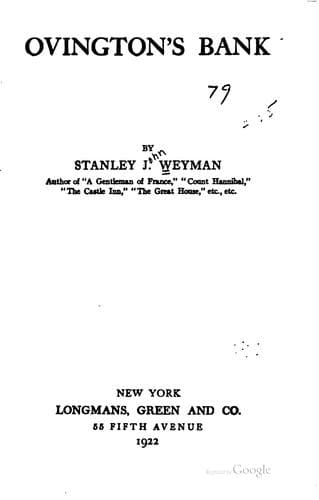
Banks and banking -- Fiction; England -- Social life and customs -- 19th century -- Fiction; Love stories
“I’ll find him,” Clement said. And he meant it. His blood was hot, he
had tasted of adventure and he found it more to his liking than
day-books and ledgers. And already he had made up his mind that it was
his business to pursue Thomas. He was angered by the rascal’s cowardly
attack upon an old man, and were it only for that he would take him.
But apart from that he saw that if he recovered the Squire’s money it
would be another point to his credit—if the Squire recovered. If the
old man did not, well, still he would have done something. As he rode
home, and passed the scene of the robbery, he laid his plans.
He would leave the search in that district to the Head Constable at
Aldersbury. But he expected little from this. In those days if a man
was robbed it was the man’s own business and that of his friends to
follow the thief and seize him if they could. In London the Bow Street
Runners saw to it, and in one or two of the big cities there were
police officers organized on similar lines. But in the country there
were only parish constables, elderly men, often chosen because they
were past work.
Clement knew, then, that he must rely on himself, and he tried to
imagine what Thomas would do, and what route he would take if he made
for Manchester. Not through Aldersbury, for there he would run the risk
of recognition. Nor would he venture into either of the direct roads
thence—through Congleton or by Tarporley; for it was along these roads
that he would be likely to be followed. How, then? Through Chester,
Clement fancied. The man was already on the Chester side of Aldersbury,
and he could make at once for that place, while in the full stream of
traffic between Chester and Manchester his traces would be lost.
Travelling on foot and by night, he might reach Chester about ten in
the morning, and probably, having money and being footsore, he would
take the first Manchester coach that left after ten.
At this point Clement found himself crossing the West Bridge, the faint
scattered lights of the town rising to a point before him. His first
business was to knock up the constable and tell his tale. This done, he
made for the bank, where he found the household awaiting his coming in
some alarm, for it was close on midnight. Here he had to tell his story
afresh, amid expressions of wonder and pity, while Betty fetched sponge
and water and bathed his cheek; nor, modestly as he related his doings,
could he quite conceal the part that he had played. The banker
listened, approved, and for once experienced a new sensation. He was
proud of his son. Moreover, as a dramatic sequel to the Squire’s
withdrawal of the money, the story touched him home.
Then Clement, as he ate his supper, came to his point. “I’m going after
him,” he said.
The banker objected. “It’s not your business, my lad,” he said. “You’ve
done enough, I’m sure.”
“But the point is—it’s bank money, sir.” Clement had grown cunning.
“It was—this morning.”
Public-domain text, read in full here on John Shaqi.
Reviews
Reviews
No reviews yet
Be the first to share your thoughts on this work.
Elsewhere in the archive
Join the Discussion
Join the discussion
Sign in to leave a comment or review.
Sign InorCreate an account