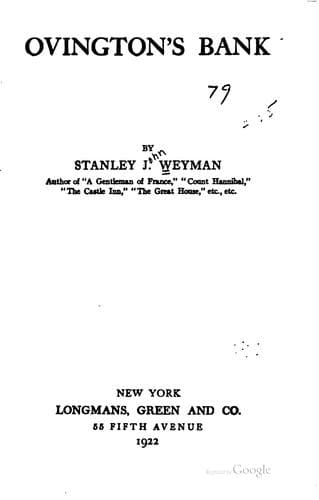
Banks and banking -- Fiction; England -- Social life and customs -- 19th century -- Fiction; Love stories
“And he was a client this morning—and may be tomorrow.”
The banker considered. There was something in that; and this sudden
interest in the bank was gratifying. Yet—yet he did not quite
understand it. “You seem to be confoundedly taken up with this,” he
said, “but I don’t see why you need mix yourself up with it farther.
The scoundrel’s neck is in a halter and he won’t be taken without a
struggle. Have you thought of that?”
“I’d take him if he were ten,” Clement said—and blushed at his own
enthusiasm. He muttered something about the man being a villain, and
the sooner he was laid by the heels the better.
“Yes, by someone. But I don’t see why you need be the one.”
“Anyway, I’m going to do it, sir,” Clement replied with unexpected
independence. “I shall go by the Nantwich coach at half-past five, drop
off at Altringham, and catch him as he goes through. True, if he goes
by Frodsham I may miss him, but I fancy that the morning coach by
Frodsham leaves Chester too early for him. And, after all, I can’t stop
every bolt-hole.”
Ovington wondered anew, seeing his son in a new light. This was not the
idler with his eyes on the ledger and his thoughts abroad, whom he had
known in the bank, but a young man with purpose in his glance and a cut
on his cheek-bone, who looked as if he could be ugly if it came to a
pinch. A quite new Clement—or new at any rate to him.
He reflected. The affair would be talked of, and certainly it would be
a feather in the bank’s cap if the money, which the Squire had
withdrawn, were recovered through the bank’s exertions. Viewed in that
light there was method in the lad’s madness, whatever had bitten him,
“Well, I think it is a dangerous business,” he said at last, “and it is
not your business. But go, if you will, only you must take Payne with
you.”
Payne was the bank man-of-all-work, but Clement would not hear of
Payne. If he could be called at five, he asked no more. Even if all the
seats on the Victory were booked, they would find room for him
somewhere.
“But your face?” Betty said. “Isn’t it painful? It’s turning black.”
“I’ll bet that villain’s is as black!” he retorted. “I know I got home
on him once. Only let me be called.”
But his father saw that, as he passed through the hall, he took one of
the bank pistols out of the case in which they were kept, and slipped
it into his pocket. The banker wondered anew, and felt perhaps more
anxiety than he showed. At any rate, it was he who called the lad at
five and saw that he drank the coffee that Betty had prepared, and that
he ate something. At the last, indeed, Clement feared that his father
might offer to accompany him, but he did not. Possibly he had decided
that if his son was bent on proving his mettle in this odd business, it
was wisest not to balk him.
Public-domain text, read in full here on John Shaqi.
Reviews
Reviews
No reviews yet
Be the first to share your thoughts on this work.
Elsewhere in the archive
Join the Discussion
Join the discussion
Sign in to leave a comment or review.
Sign InorCreate an account