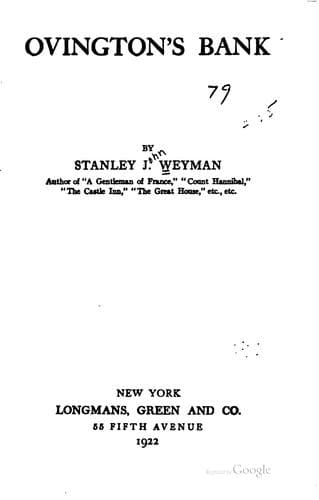
Banks and banking -- Fiction; England -- Social life and customs -- 19th century -- Fiction; Love stories
Clement ran briefly over his adventures. When he had done, “Deuced
sharp of you,” Arthur said. “Devilish sharp, I must say! Now, if you’ll
hand over I’ll take it out to Garth. I am on my way there, I’m just
starting, and I haven’t a moment to spare. If you’ll hand over——”
But Clement made no move to hand over. Instead, “How is he?” he asked.
“Oh, pretty bad.”
“Will he get over it?”
“Farmer thinks so. But there’s no hope for the eye, and he doubts about
the other eye. He’s not to use it for six weeks at least.”
“He’s in bed?”
“Lord, yes, and will be in bed for heaven knows how long—if he ever
gets up from it. Why, man, he’s had the deuce of a shake. The wonder is
that he’s alive, and it’s long odds that he’ll never be the same man
again.”
“That’s bad,” Clement said. “And how is——” He was going to inquire
after Miss Griffin, but Arthur broke in on him.
“Ask the rest another time,” he said. “I can’t stay now. I’m taking out
things that are wanted in a hurry and the curricle is waiting. This is
the first day I’ve been in town, for there’s no one there to do
anything except my cousin and the old Peahen. So hand over, old chap,
and I’ll take the stuff out. It will do the old man more good than all
the doctor’s medicine.”
Clement hesitated. If he had not been carrying the money, he might have
made an excuse. He might at any rate have delayed the act. But the
money was the Squire’s, he could give no reason for taking it to the
bank, and he had not that hardness of fibre, that indifference to the
feelings of others which was needed if he was to say boldly that it was
he who had recovered the money and he who was going to hand it over.
Still he did hesitate, something telling him that the demand was
unreasonable. Then Arthur’s coolness, his assumption that what he
proposed was the natural course did its work. Clement handed over the
bag.
“Right,” Arthur said, weighing it in his hand. “You counted it, I
suppose? Four hundred and thirty, or thereabouts?”
“That’s it.”
“Good! See you soon. Good-bye!” And well pleased with himself,
chuckling a little—for Clement’s discomfiture had not escaped
him—Arthur hurried away.
And Clement went his way. But reality had touched his golden dreams,
and they had melted. The sun still shone, but it did not shine for him,
and he no longer walked with his head in the air. It was not only that,
by resigning the money and entrusting its return to another, he had
lost the advantage on which he had counted, but he had been worsted. He
had failed, in the contest of wits and wills, and, abuse his ill-luck
as he might, he owed the failure to himself—to his own weakness. He saw
it.
Public-domain text, read in full here on John Shaqi.
Reviews
Reviews
No reviews yet
Be the first to share your thoughts on this work.
Elsewhere in the archive
Join the Discussion
Join the discussion
Sign in to leave a comment or review.
Sign InorCreate an account