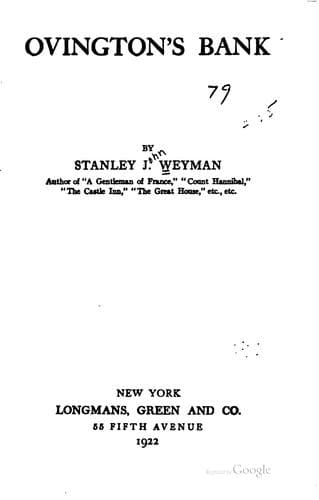
Banks and banking -- Fiction; England -- Social life and customs -- 19th century -- Fiction; Love stories
It was possible that Arthur had acted in innocence. But Clement doubted
this, and he doubted it the more the longer he thought of it. He
fancied that he recognized a thing which had happened before: that this
was not the first time that Arthur had taken the upper hand with him
and jockeyed him into the worse position. As he crossed the threshold
of the bank, his self-confidence fell from him, he felt himself slip
into the old atmosphere, he became once more the inefficient.
Nor was it any comfort to him that his father saw the matter in the
same light, and after listening with an appreciative face and some
surprise to his earlier adventures, made no effort to hide the chagrin
that he felt at the _dénouement_. “But why—why in the world did you do
that?” he exclaimed. “Give up the money after you had done the work?
And to Bourdillon, who had no more right to it than you had? Good
heavens, lad, it was the act of a fool! I’d not be surprised if old
Griffin never heard your name in connection with it!”
“Oh, I don’t think Arthur——”
“Well, I do.” The banker was vexed. “It’s clear that Arthur is a deal
sharper than you. As for the Squire, I hear that he is only
half-conscious, and what he hears, if he ever hears the tale at all,
will make little impression on him. Now if he had seen you, and you’d
handed over the money—if he had seen you, then the bank and you would
have got the credit.”
“Still, Clem did recover it,” Betty said.
“Ay, but who will ever know that he did?”
“Still he did, and I believe that he’ll get a message from Garth
to-morrow. Now, see if you don’t, Clem. Or the next day.”
But no message came on the morrow, or on the next day. No message came
at all; and though it was possible to attribute this to the Squire’s
condition—for he was reported to be very ill—and Clement did his best
to attribute it to that and to keep up his spirits, the tide of time
wears away even hope, and presently he began to see that he had built
on the sand.
At any rate no message and no acknowledgment came, unless a perfunctory
word of thanks dropped by Arthur counted as such. And Clement had soon
to recognize that what he had done, he might as well, for any good it
was likely to do him, have left undone. His father, who had no thought
of anything but his son’s credit, was merely chagrined. But with
Clement, who had built high hopes upon the event, hopes of which his
father and Betty little dreamed, the wound went far deeper.
CHAPTER XVIII
Public-domain text, read in full here on John Shaqi.
Reviews
Reviews
No reviews yet
Be the first to share your thoughts on this work.
Elsewhere in the archive
Join the Discussion
Join the discussion
Sign in to leave a comment or review.
Sign InorCreate an account