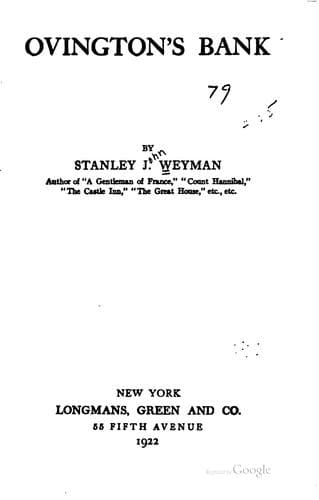
Banks and banking -- Fiction; England -- Social life and customs -- 19th century -- Fiction; Love stories
The Squire raised himself painfully on his elbow and hid the bag
between pillow and tester, where he could assure himself of its
presence by a touch. Then he sank back with a grunt of relief and his
hand went to the keys, which also had their home under his pillow. He
clung to them—they were his badge of authority, of power. While he had
them, sightless as he was, he was still master; about his room, the
oak-panelled chamber, spacious but shabby, with the uneven floor and
the low wide casement, the life of the house still circled.
“Good lad!” he muttered. “Good lad! Jos?”
“Yes, father.” She rose and came towards him.
“Where’s Arthur?”
“He went out with your message.”
“To be sure! To be sure! I’m forgetting.”
But, once started on the road to recovery, he did not forget much. From
his high, four-post bed with the drab hangings in which his father and
grandfather had died, he gripped house and lands in a firm grip.
Morning by morning he would have his report of the lambs, of the wheat,
of the hay-corps, of the ploughing on the eight acres where the Swedish
turnips were to go. He would know what corn went to the mill, what
mutton to the house. The bounds-fence that Farmer Bache had neglected
was not forgotten, nor the young colt that he had decided to take
against Farmer Price’s arrears, nor the lease for lives that involved a
knotty point of which he proved himself to be in complete possession.
Indeed, he showed himself indomitable, the old heart in him still
strong; so that neither the shock that he had borne, nor the pain that
he had suffered, nor the possibility of permanent blindness which they
could not wholly hide from him, sufficed to subdue or unman him.
Only in one or two things was a change apparent. He reverted more often
to an older and ruder form of speech familiar to him when George the
Third was young, but which of late he had only used when talking with
his tenants. He said “Dunno you do this!” and “I wunt ha’ that!” used
“ship” for sheep, and “goold” for gold, called Thomas a “gallus bad
rascal,” and the like.
And in another and more important point he was changed. For eyes he
must now depend on someone, and though he showed that he liked to have
Jos about him and bore with her when the Pea-hen’s fussiness drove him
to bad words, it was soon clear that the person he chose was Arthur.
Arthur was restored, and more than restored to favor. It was “Where’s
Arthur?” a score of times a day. Arthur must come, must go, must be
ever at his elbow. He must check such and such an account, see the
overseers about such an one, speak to the constable about another, go
into Aldersbury about the lease. Even when Arthur was absent the
Squire’s thoughts ran on him, and often he would mutter “Good lad! Good
lad!” when he thought himself alone.
Public-domain text, read in full here on John Shaqi.
Reviews
Reviews
No reviews yet
Be the first to share your thoughts on this work.
Elsewhere in the archive
Join the Discussion
Join the discussion
Sign in to leave a comment or review.
Sign InorCreate an account