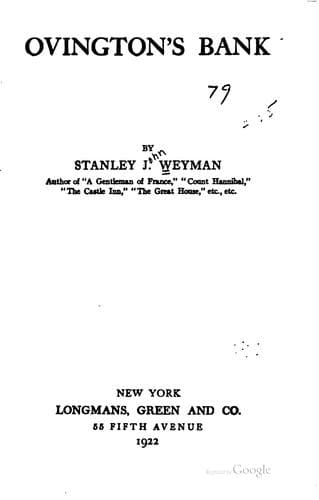
Banks and banking -- Fiction; England -- Social life and customs -- 19th century -- Fiction; Love stories
She went, wondering a little for she had not been dismissed before. She
sent Arthur, who, after his usual fashion, scaled the stairs at three
bounds. He found the old man sitting up in the shadow of the curtains,
a grotesque figure with his bandaged head. The air of the room was not
so much musty as ancient, savoring of worm-eaten wood and long decayed
lavender, and linen laid by in presses. On each side of the drab tester
hung a dim flat portrait, faded and melancholy, in a carved wooden
frame, unglazed; below each hung a sampler. “You sent for me, sir?”
“Ay. When’s that money due?”
The question was so unexpected that for a moment Arthur did not take it
in. Then the blood rushed to his face. “My mother’s money, sir?”
“What else? What other money is there, that’s due? I forget things but
I dunno forget that.”
“You don’t forget much, sir,” Arthur replied cheerfully. “But there’s
no hurry about that.”
“When?”
“Well, in two months from the twenty-first, sir. But there is not the
least hurry.”
“This is the seventeenth?”
“Yes, sir.”
“Well, I’ll pay and ha’ done with it. But I’ll ha’ to sell stock. East
India Stock it is. What are they at, lad?”
“Somewhere about two hundred and seventy odd, I think, sir.”
“And how do you sell ’em?” The Squire knew a good deal about buying
stock but little about selling it, and he winced as he put the
question. But he bore the pang gallantly, for had not the boy earned
his right to the money and to his own way? Ay, and earned it by a
service as great as one man could perform for another? For the Squire
had no more reason than those about him to doubt that he owed his life
to his nephew. He had found him beside his bed when he had recovered
his senses, and putting together this and certain words which had
fallen from others, and adding his own hazy impressions of the
happenings of the night, and of the young man on whose shoulder he had
leant, he had never questioned the fact. “How do you go about to sell
’em?” he repeated. “I suppose you know?”
“Oh, yes, sir, it’s my business,” Arthur replied. “You have to get a
transfer—they are issued at the India House. You’ve only to sign it
before two witnesses. It is quite simple, sir.”
“Well, I can do that. Do you see to it, lad.”
“You wouldn’t wish to do it through Ovington’s?”
“No!” the Squire rapped out. “Do it yourself. And lose no time. Write
at once.”
“Very well, sir. I suppose you have the certificates?”
“’Course I have,” annoyed. “Isn’t the stock mine?”
“Very good, sir. I’ll see to it.”
“Well, see to it. And, mark ye, when you’re in Aldersbury see Welshes,
and tell them I’m waiting for that lease of lives. I signed the
agreement for the new lease six weeks ago and I should ha’ had the
lease by now. Stir ’em up, and say I must have it. The longer I’m
waiting the longer the bill will be! I know ’em, damn ’em, though
Welshes are not the worst.”
Public-domain text, read in full here on John Shaqi.
Reviews
Reviews
No reviews yet
Be the first to share your thoughts on this work.
Elsewhere in the archive
Join the Discussion
Join the discussion
Sign in to leave a comment or review.
Sign InorCreate an account