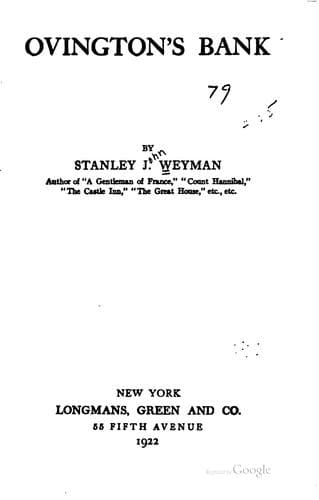
Banks and banking -- Fiction; England -- Social life and customs -- 19th century -- Fiction; Love stories
When he had settled this he wanted a letter written, and Arthur sat
down at the oaken bureau that stood between the windows, its faded
green lining stained with the ink of a century and its pigeon-holes
crammed with receipts and sample-bags. While he wrote his thoughts were
busy with the matter that they had just discussed, but it was not until
he found himself standing at a window outside the room, staring with
unseeing eyes over the green vale, that he brought his thoughts to a
head, and knew that even at the eleventh hour he hesitated.
Yes, he hesitated. The thing that he had so much desired, that had
presented itself to him in such golden hues, that had dazzled his
ambition and absorbed his mind, was within his grasp now, ready to be
garnered—and yet he hesitated. Ovington was a just man and beyond doubt
would release him and cancel the partnership agreement, if he desired
to have it cancelled. And he was very near to desiring it at this
moment.
For he saw now that there were other things to be garnered—Garth, its
broad acres, its fine rent-roll, the old man’s savings, Josina. Secure
of the Squire’s favor he had but to stretch out his hand, and all these
things might be his; might certainly be his if he gave up the bank and
his prospects there. That step, if he took it, would remove his uncle’s
last objection; it would bind him to him by a triple bond. And it would
do more. It would ease his own mind, by erasing from the past—for he
would no longer need the five thousand—a thing which troubled his
conscience and harassed him when he lay awake at night. It would erase
that blot, it would make all clean behind him, and it would at the same
time remove the impalpable barrier that had risen between him and his
mother.
It was still in his power to do all this. A word would do it. He had
only to go back to the Squire and tell him that he had changed his
mind, that he no longer wanted the money, and was not going into the
bank.
He hesitated, standing at the window, looking on the green vale and the
hillside beyond it. Yes, he might do it. But what if he repented later?
And what security had he for those other things? His uncle might live
for years, long years, might live to quarrel with him and discard him.
Did not the proverb say that it was ill-work waiting for dead men’s
shoes? And Josina? Doubtless he might win Josina, for the wooing; he
had no doubt about that. But he was not sure that he wanted Josina.
He decided at last that the question might wait. Until he had written
the letter to the brokers, until then, at any rate, either course was
open to him. He went downstairs. In the wainscoted hall, small and
square, with a high narrow window on each side of the door, his mother
and Josina were sitting on one of the window seats. The door stood
open, the spring air and the sunshine poured in. “I’m telling her that
she’s not looking well,” his mother said, as he joined them.
Public-domain text, read in full here on John Shaqi.
Reviews
Reviews
No reviews yet
Be the first to share your thoughts on this work.
Elsewhere in the archive
Join the Discussion
Join the discussion
Sign in to leave a comment or review.
Sign InorCreate an account