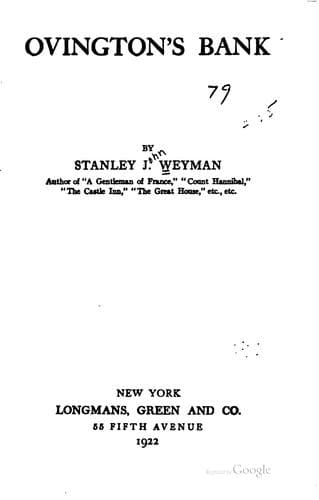
Banks and banking -- Fiction; England -- Social life and customs -- 19th century -- Fiction; Love stories
“Well,” said Arthur. “I’ll tell you why I asked. There’s a question
arisen about a lease for lives—his is one. But you won’t talk, of
course.”
Farmer nodded. He found it quite natural. Leases for lives were still
common, and doctors were often consulted as to the value of lives which
survived or which it was proposed to insert. With another word or two
they parted and Arthur rode on.
But he no longer doubted. To wait for eight or ten years, dependent on
the whims of an arbitrary and crotchety old man? No! Only in a moment
of imbecility could he have dreamed of resigning for this, the golden
opportunities that the new world, opening before him, offered to all
who had the courage to seize them. He had been mad to think of it, and
now he was sane. Garth was worth a mass. He might have served a year or
two for it. But seven, or it might be ten? No. Besides, why should he
not take the Squire at his word and make the best of both worlds, and
availing himself of the favor he had gained, employ the one to exploit
the other? He had his foot in at Garth and he was no fool, he could
make himself useful. Already, he was well aware, he had made himself
liked.
It was noon when he rode into Aldersbury, the town basking in the first
warmth of the year, the dogs lying stretched in the sunshine. And he
was in luck, for, having met Farmer, he now met Frederick Welsh coming
down Maerdol. The lawyer, honestly concerned for his old friend, was
urgent in inquiry, and when he had heard the news, “Thank God!” he
said. “I’m as pleased to hear that as if I’d made a ten-pound note!
Aldshire without the Squire—things would be changing, indeed!”
Arthur told him what the Squire had said about the lease. But that was
another matter. The Squire was too impatient. “He’s got his agreement.
We’ll draw the lease as soon as we can,” the lawyer said. “The office
is full, and more haste less speed. We’ll let him know when it’s
ready.” Like all old firms he was dilatory. There was no hurry. All in
good time.
They parted, and Arthur rode up the street, alert and smiling, and many
eyes followed him—followed him with envy. He worked at the bank, he had
his rooms on the Town Walls, he chatted freely with this townsman and
that. He was not proud. But they never forgot who he was. They did not
talk to him as they talked even to Ovington. Ovington had risen and was
rich, but he came as they came, of common clay. But this young man,
riding up the street in the sunshine, smiling and nodding this way and
that, his hand on his thigh, belonged to another order. He was a
Griffin—a Griffin of Garth. He might lose his all, his money might fly
from him, but he would still be a Griffin, one of the caste that ruled
as well as reigned, that held in its grasp power and patronage. They
looked after him with envy.
CHAPTER XIX
Public-domain text, read in full here on John Shaqi.
Reviews
Reviews
No reviews yet
Be the first to share your thoughts on this work.
Elsewhere in the archive
Join the Discussion
Join the discussion
Sign in to leave a comment or review.
Sign InorCreate an account