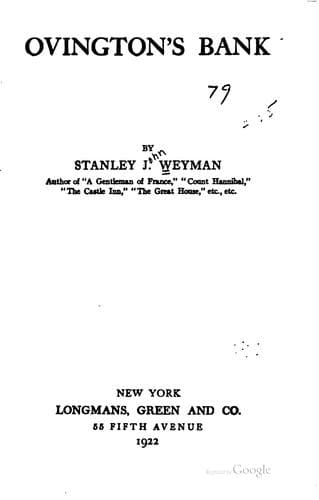
Banks and banking -- Fiction; England -- Social life and customs -- 19th century -- Fiction; Love stories
“She spends too much time in that room,” he answered. Then, after a
moment’s thought, rattling the money in his fob, “Is Farmer coming
to-day?”
“No.” The girl spoke listlessly. “I don’t think he is.”
“He’s made a wonderful recovery,” his mother observed.
“Yes—if it’s a real recovery.”
“At any rate, the doctor hopes that he may come downstairs in ten days.
And then, I’m afraid, we shall have Josina to nurse.”
The girl protested that she was well, quite well. But her heavy eyes
and the shadows under them belied her words.
“Well, I’m off to town,” he said, “I have to see Welshes for him.”
He left them, and ten minutes later he was on the road to Aldersbury,
still undecided, still uncertain what course he would pursue, and at
one moment accusing himself of a weakness that deserved the contempt of
every strong man, at another praising moderation and a country life.
Had he had eyes and ears for the things about him as he rode, he might
have found much to support the latter view. The cawing of rooks, the
murmur of wood-doves, the scents of late spring filled the balmy air.
The sky was pure blue, and beneath it the pastures shone yellow with
buttercups. Tree and field, bank and hedge-row rioted in freshest
green, save where the oak wood, slow to change and careless of fashion,
clung to its orange garb, or the hawthorn stood out, a globe of snow.
The cuckoo and the early corncrake told of coming summer, and behind
him the Welsh hills simmered in the first heat of the year. Clement,
had he passed that way, would have noted it all, and in the delight of
the eye and the spring-tide of all growing things would have found
ground to rejoice, whatever his trouble.
But Arthur, wrapt in his own thoughts, barely noticed these things. He
rode with his eyes fixed on his horse’s ears, and only roused himself
when he saw the very man whom he wished to see coming to meet him. It
was Dr. Farmer, in the mahogany-topped boots, the frilled shirt, and
the old black coat—shaped as are our dress coats but buttoned tightly
round the waist—which the dust of a dozen summers and every road in the
district had whitened.
“Hallo, doctor!” Arthur cried as they met. “Are you going up to the
house to-day?”
“No, Mr. Bourdillon. But I can if necessary. How is he?”
“That is what I want you to tell me. One can’t talk freely at the house
and I have a reason for wishing to know. How is he, doctor?”
“Do you mean——”
“Has this really shaken him? Will he be the same man again?”
“I see.” Farmer rubbed his chin with the horn-handle of his
riding-crop. “Well—I see no reason at present why he should not be.
He’s one in a hundred, you know. Sound heart, good digestion, a little
gouty—but tough. Tough! You never know, of course. There may be some
harm we haven’t detected, but I should say that he had a good few years
of life in him yet.”
“Ah!”
“Of course, an unusual recovery—from such injuries. And I say nothing
about the sight. I’m not hopeful of that.”
Public-domain text, read in full here on John Shaqi.
Reviews
Reviews
No reviews yet
Be the first to share your thoughts on this work.
Elsewhere in the archive
Join the Discussion
Join the discussion
Sign in to leave a comment or review.
Sign InorCreate an account