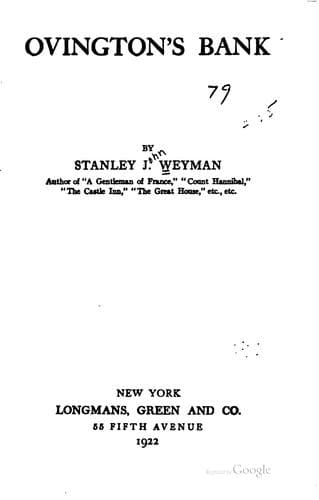
Banks and banking -- Fiction; England -- Social life and customs -- 19th century -- Fiction; Love stories
Not that Arthur saw them as beacons, for at no time was he much given
to sentiment. His outlook on life was too direct and vivid for that,
and to-day in particular his mind was teeming with more practical
thoughts, with hopes and plans and calculations. But the lights meant
that a dull ride over a rough road was at an end, and so far they gave
him pleasure. He opened the gate and rode round to the stable, gave up
the horse to Pugh, the man-of-all-work, and made his way into the
house.
He entered upon a scene as cheerful as any lights shining on weary
traveller could promise. In a fair-sized room a clear grate held a coal
fire, the flames of which danced on the red-papered walls. A kettle
bubbled on the hob, a tea-tray gleamed on the table, and between the
two a lady and gentleman sat, eating crumpets; the lady with much
elegance and a napkin spread over her lavender silk dress, the
gentleman in a green cutaway coat with basket buttons—a coat that ill
concealed the splashed gaiters for which he had more than once asked
pardon.
But fair as things looked on the surface, all was not perfect even in
this pleasant interior. The lady held herself stiffly, and her eyes
rested rather more often than was courteous on the spatter-dashes.
Secretly she thought her company not good enough for her, while the
gentleman was frankly bored. Neither was finding the other as congenial
as a first glance suggested, and it would have been hard to say which
found Arthur’s entrance the more welcome interruption.
“Hallo, mother!” he said, stooping carelessly to kiss her. “Hallo,
Clement.”
“My dear Arthur!” the lady cried, the lappets of her cap shaking as she
embraced him. “How late you are! That horrid bank! I am sure that some
day you will be robbed and murdered on your way home!”
“I! No, mother. I don’t bring the money, more’s the pity! I am late, am
I? The worse for Clement, who has to ride home. But I have been doing
your work, my lad, so you mustn’t grumble. What did you get?”
“A brace and a wood-pigeon. Has my father come?”
“Yes, he has come, and I am afraid has a wigging in store for you.
But—a brace and a wood-pigeon? Lord, man,” with a little contempt in
his tone, “what do you do with your gun all day? Why, Acherley told me
that in that rough between the two fallows above the brook——”
“Oh, Arthur,” Mrs. Bourdillon interposed, “never mind that!” She had
condescended sufficiently, she thought, and wished to hear no more of
Clement Ovington’s doings. “I’ve something more important to tell you,
much more important. I’ve had a shock, a dreadful shock to-day.”
She was a faded lady, rather foolish than wise, and very elegant: one
who made the most of such troubles as she had, and the opening her son
now heard was one which he had heard often before.
“What’s the matter now, mother?” he asked, stooping to warm his hands.
“Your uncle has been here.”
“Well, that’s no new thing.”
“But he has behaved dreadfully, perfectly dreadfully to me.”
Public-domain text, read in full here on John Shaqi.
Reviews
Reviews
No reviews yet
Be the first to share your thoughts on this work.
Join the Discussion
Join the discussion
Sign in to leave a comment or review.
Sign InorCreate an account