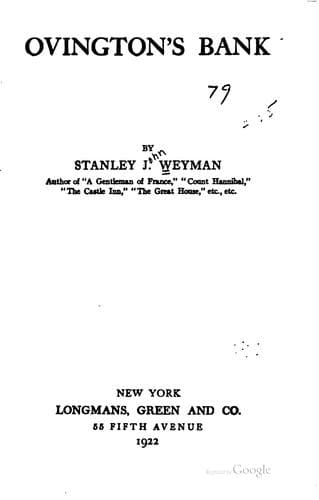
Banks and banking -- Fiction; England -- Social life and customs -- 19th century -- Fiction; Love stories
“But our money is well covered.”
“As things are.”
“And we are as solvent, sir, as——”
“As need be, with the ordinary time to meet the calls that may be made
upon us. But in the event of a sudden fall, of one big failure leading
to another—in the event of a sudden rush to present our notes?”
“Even then, sir, we are well secured. We should have no difficulty in
finding accommodation.”
“In ordinary circumstances, no—and if we alone needed it. We could go
to A. or B. or C, and there would be no difficulty. We have the money’s
worth and a good margin. But if A. and B. and C. were also short, what
then, lad?”
Arthur felt something approaching contempt. The banker was inventing
bogies, imagining dangers, dreaming of difficulties where none existed.
He saw him in a new light, and discovered him to be timorous. “But that
state of things is not likely to occur,” he objected.
“Perhaps not, but if it did?”
“Have you had any hint?”
“No. But I see that iron is down—since Saturday. And the Manchester
market was flat yesterday.”
“Things that have happened before,” Arthur said. “I think, sir, it is
really Wolley’s affair that is troubling you.”
“If it ended with Wolley it would be a small matter. No, I am not
thinking of that.” He looked before him and drummed upon the table with
his fingers. “But the positions calls for—caution. We must go no
farther. We must be careful how we grant accommodation no matter who
applies for it. We must raise our reserve. See, if you please, that we
do not discount a single bill without recourse to me—though, of course,
you will let nothing be noticed on the other side of the counter.”
“Very good,” Arthur said. But he thought that the other’s caution was
running away with him. The sky seemed clear to him—he could discern no
sign of a storm, and he did not reflect that, as he had never been
present at a storm, the signs might escape him. “Very good,” he said,
“I’ll tell Rodd. I am sure it will please him,” and with that tiny
sting, he went out.
The conversation had been held behind closed doors, yet it had its
effect. A chill seemed to fall upon the bank. The air became less
genial. Ovington’s face grew both keen and watchful. Arthur, perplexed
and puzzled, was more brusque, his speech shorter. Rodd’s face
reflected his superiors’ gravity. Only Clement, going about his branch
of the work with his usual stolid indifference, perceived no change in
the temperature, and, depressed before, was only a degree nearer to the
mean level.
Public-domain text, read in full here on John Shaqi.
Reviews
Reviews
No reviews yet
Be the first to share your thoughts on this work.
Elsewhere in the archive
Join the Discussion
Join the discussion
Sign in to leave a comment or review.
Sign InorCreate an account